 Artificially generated
COGNILYTICS
How do you measure a thought? There are two ways in. Open a brain, or build one. This field manual does both and watches them meet.
Cognilytics is our word for the whole toolkit that analyses and measures thinking: the shape of an abstract idea in a crowd of neurons, the brain state you slip into when your mind wanders, the theta rhythm over your forehead when a problem gets hard, the score on a memory test. The first half of this manual dives from the inside of the brain out to the clinic, newest work on internal abstraction first.
The second half turns around. Since we started building agents, systems that think along with us, we are rebuilding the mind from the outside. Every organ an agent lacks shows up first as a failure, and the fix often turns out to be something the brain has done all along. So each layer of the dive carries a violet mirror from the built side. Then come three new chapters on consciousness engineering: the organs we had to build, the line between a cell and a swarm, and how to count the throughput of a mind in tokens, joules and hours. At the end the whole article folds into one flowchart.
Know, ken, can, cognition. One root, five thousand years.
Cognitive entered English in the late 16th century, with the earliest evidence around 1586. It means "relating to the action or process of knowing". It is a borrowing from Latin cognītīvus, built from cognit-, the stem of cognitus, past participle of cognōscere, plus the adjective suffix -īvus, our "-ive".
Cognōscere means to get to know, to learn, to recognise. It is co- (together, with) plus gnōscere (to know). And gnōscere goes back to the Proto-Indo-European root *ǵneh₃-, "to know". That root is one of the most productive in the family. It gave English know and ken directly, through Germanic. It came back in through Latin as cognition, recognise, ignore and noble (Latin nōbilis, "known, famous"). It came back again through Greek as diagnosis, prognosis and agnostic.
The noun cognition is slightly older in English, mid-15th century, from Latin cognītiō, "a getting to know". The adjective stayed a specialist word for almost four centuries. Then psychology adopted it. Leon Festinger's cognitive dissonance (1957) and Ulric Neisser's book Cognitive Psychology (1967) made it central, and today it carries cognitive science, neuroscience and AI.
So the word we use for this manual says: untie the knot of knowing. Take a thought apart until you can count something.
An abstraction has a shape you can measure.
The deepest layer of cognilytics does not ask where a thought lives. It asks what shape it has. Picture every possible situation in a task as one point in a space with as many dimensions as you recorded neurons. A concept, like "the context changed" or "this choice pays", is a direction through that cloud.
In 2020 a team at Columbia recorded from monkey hippocampus and prefrontal cortex while the animals did a task with hidden context switches. They defined abstraction by what it lets you do. Train a simple linear decoder to read a variable on some conditions, then test it on conditions it never saw. If it still works, the variable is stored in an abstract format. They called the score cross-condition generalisation performance, CCGP. The geometric reason it works is parallel coding: the arrow from "context A" to "context B" points the same way, whatever else is going on.
The surprise was the second number. The same neural clouds also had high shattering dimensionality: a linear readout could still split the points in almost any way you asked. So the brain keeps abstraction and fine detail at once. Simulated neural networks trained on the task landed in the same geometry. Press the buttons and watch both numbers move.
Four conditions, one concept
Goal-progress cells, medial frontal cortex
Abstraction also shows up as a map of a task, the way place cells map a room. In Oxford, mice learned many tasks that shared one structure, a loop of four goals A, B, C, D on a three by three maze, while the goal locations changed from task to task. They learned the structure so well that on the first trial of a new task they made correct guesses they could not have learned from that task.
Most recorded neurons in medial frontal cortex tiled progress toward the next goal, not physical position. When the distance between goals changed, the tiling stretched or compressed to fit. A subset formed what the authors call structured memory buffers, which held the whole sequence of future steps at once. The same dynamics replayed during sleep.
For cognilytics this is the cleanest kind of measurement there is: a variable that exists only in the abstract (how far along am I in the plan), read straight from cells.
Machines found the same geometry. Anthropic pulled about 34 million interpretable features out of one production model with sparse autoencoders in 2024: directions in activation space for the Golden Gate Bridge, for code bugs, for flattery. A linear probe that reads a feature from a model is the same instrument as the CCGP decoder that reads context from a monkey. Builders did not borrow this from neuroscience. They needed it, because an agent whose concepts are tangled cannot reuse them on a new task. That is the first lesson of the rebuild: abstraction is not a luxury, it is what makes transfer cheap.
Deep thinking is information-rich and compressible at once.
You would expect a trade. A brain pattern that carries a lot of specific information should be messy and need many numbers to describe it. A pattern that compresses well should be simple and say little. Jeremy Manning said his team expected exactly that. They found the opposite.
They reused fMRI from people who listened to a seven-minute story in four ways: intact, with paragraphs shuffled, with words shuffled, and not at all (rest). Informativeness was the peak accuracy of a decoder that guesses, across people, which moment of the recording a brain snapshot came from. Compressibility was how few principal components the decoder needed to pass a fixed accuracy bar.
The intact story won both contests. It gave the highest peak accuracy and needed the fewest components. Over the course of the story, the richer conditions became more informative and more compressible, while the poorer ones lost both. The change was strongest in higher-order networks, the frontoparietal and default mode systems, and weakest in sensory cortex.
In plain words: when you are really following something, your brain folds the meaning into fewer, stronger dimensions. That is a measurable signature of understanding, and it is the core metric of internal abstraction work.
Decoding accuracy vs. number of components
Every agent has a compression budget. An agent runs into the same trade every few minutes. Its context window fills, and it has to fold what it knows into a summary that is small and still useful for the next step. Builders call it compaction. A good summary is exactly what Owen and Manning measured: high informativeness, few dimensions. Our own fleet shows the other half. In 30 days 97% of everything our agents read came from cache, text they had already seen. Only 3% was new. The brain is thought to work the same way: predict what is coming and pay only for the surprise.
Think out loud in a scanner and your mind becomes a sequence of states.
William James called it the stream of consciousness. A 2025 study finally put a ruler next to it. People lay in an fMRI scanner and spoke their unprompted thoughts aloud, minute after minute. A hidden Markov model found a small set of latent brain states that the brain kept returning to, and lined them up against what people were saying.
Two details make this a cognilytic instrument and not just a picture. First, novelty was measured with a language model: the perplexity of each spoken thought, how surprising its words were. Higher perplexity went with more time in the medial temporal state. Second, people had stable habits. The states they favoured at rest predicted the states they favoured while thinking aloud. Your stream has a fingerprint. A companion analysis of the same kind of data found the hippocampus responding at thought boundaries, the moments one thought ends and the next begins.
An agent thinks aloud by design. Think, act, observe, think again. A modern agent writes its reasoning as tokens before it answers, so its stream is on the record. In our fleet a third of all output tokens (34%) are reasoning, never shown to anyone. Segment such a trace and you get states like the ones in the scanner: planning (inward), tool calls (outward), and elaboration after a surprising tool result. The boundary problem is the same too. When you send a second message while the agent is still busy, the new sentence is the next thought, not a cancellation. We had to build a queue for it. The hippocampus marks the same seams.
Decoders now turn brain activity back into words, pictures and plans.
If abstraction has geometry, you can fit a model to it and run it backwards. Five results from the last fifteen months show how far that has come.
Sentences from what you saw or recalled
Tomoyasu Horikawa decoded language-model meaning features from fMRI, then let a masked language model rewrite a sentence word by word until its features matched. Six people watched clips for about 17 hours each. The method also described clips they only recalled, and it worked without the classic language areas.
Images from about an hour of a new brain
A Brain Interaction Transformer groups voxels into functional clusters that every subject shares. It predicts high-level meaning to steer a diffusion model and low-level layout to seed it. Shared parts mean a new person needs far less scanning.
One meaning space under 21 languages
Encoding models built on 20 multilingual language models were trained on brain data from some languages and predicted the language network's response to others they never saw, even across language families. Strip the meaning out of the model features and only 67% of the performance survives.
A decision is everywhere
Twelve labs ran one standard decision task and recorded with 699 Neuropixels probes. Signals for the choice and for prior expectations turned up across most of the brain, not in one chain of command. A distributed picture of thinking, at single-cell resolution.
Progress through a plan
Goal-progress cells (layer 01) let mice infer a new task's sequence on its very first run. Read out, they tell you where an animal is in an abstract plan, independent of where it stands.
Reading out a model uses the same playbook. In March 2025 Anthropic traced the internal steps of one of its models with attribution graphs. Asked to finish a rhyming couplet, the model picked the rhyme word before it wrote the line, then built the line toward it. Suppress the planned word and it plans another. That is a goal-progress cell in silicon. The team said it set out to show the model did not plan ahead, and found that it did. Decoding brains and decoding models are now one craft. Mind captioning and the 21-language study read brains with language-model features.
The newest models run the other way: they generate the brain.
Decoding goes from brain to content. Encoding goes from content to brain. In 2026 encoding grew up into foundation models that can stand in for experiments, which some researchers now call in-silico neuroscience.
TRIBE v2 from Meta FAIR takes a film, its soundtrack and its words, runs them through frozen video, audio and language networks, and predicts the fMRI response across the cortex. It was trained on more than 1,000 hours of fMRI from 720 people. It beats classic linear encoding models several times over on new stimuli and new subjects, and it reproduces textbook results from visual and language experiments it was never trained on. Code and weights are open for noncommercial use.
Concept2Brain does the same for EEG and for individuals. A conditional variational autoencoder squeezes each 129-channel EEG trial into 256 numbers and keeps a tag for the person. A CLIP embedding of a picture, or of a sentence, is translated into that space and decoded into synthetic brain waves. From 88 real participants it generated 10,560 synthetic trials that recover the classic event-related potential landmarks and each person's quirks. It runs as a web tool.
The closed loop
When both directions agree, you have a model of what the measurement means. When they disagree, you have found something the model does not understand yet. That gap is where the interesting cognilytics lives.
The bridge is already load-bearing. Look at what TRIBE v2 is made of: frozen video, audio and language networks trained for other jobs. Their internal features predict human cortex better than anything neuroscience built by hand. So the most accurate model of a human brain watching a film is, today, a stack of AI models. Each side has become the other side's instrument.
Out through the skull: rhythms you can wear.
Everything above needed a scanner or electrodes inside a skull. One layer out, the field has a cheaper workhorse: EEG, voltage on the scalp, millisecond timing, portable, often under a thousand euros. Its metrics are rhythms.
- Frontal midline theta, 4 to 8 Hz. Rises when mental work gets harder. A 2022 meta-analysis of EEG and workload found theta the most sensitive band, with a large pooled effect over frontal sites, Hedges' g = 0.66.
- Alpha, 8 to 12 Hz. Drops over the back of the head when you engage and attend, rebounds when you idle or close your eyes.
- Beta, 13 to 30 Hz, and gamma, above 30 Hz. Active processing and integration. Gamma is the band most hurt by muscle artefacts, so treat scalp gamma claims with care.
- Ratios and couplings. Theta/alpha and theta/beta ratios for load and fatigue. Theta-gamma phase-amplitude coupling for holding items in memory. The 1/f aperiodic exponent, the slope under the peaks, as a marker of the brain's excitation and inhibition balance. Coherence and phase-locking value for how regions talk.
Machine-learning classifiers on these features reliably separate low from high load, encoding from retrieval, and other states inside a lab. A 2025 MIT preprint, Your Brain on ChatGPT, used EEG connectivity on 54 people writing essays: those using a language model showed the weakest connectivity, search-engine users sat in the middle, brain-only writers the strongest. It is small and not peer reviewed, but it is the first wave of a new metric family: what AI help does to the measured mind.
Load mixer, frontal EEG
Every instrument trades time against space.
No single sensor sees a thought whole. Each one buys temporal or spatial resolution with something else: money, mobility, invasiveness, radiation. Hover a sensor to read its trade.
An agent has vital signs too. Theta rises when a person is loaded. For an agent the equivalent readouts are context fill (how full the working memory is), tokens per second, cache hit rate, reasoning share and time to first token. Our fleet logs all of them for every call, which is more than any EEG headset gives you about a human. What we lack on the built side is the opposite: a long clinical literature that tells us which reading means trouble.
Out through the skin: the eye gives thinking away.
The cheapest cognilytic sensor is a camera. In 1966 Daniel Kahneman and Jackson Beatty asked people to hold strings of digits in memory and filmed their eyes. The pupil widened with every extra digit and shrank as they reported them back. Pupil size has been a load meter ever since, tracking effort, surprise and arousal through the brainstem's locus coeruleus, as long as you control the light.
Gaze says where attention goes. Machine-learning models on eye-tracking data now classify, above chance and outside the lab, whether a thought is about the task, whether it looks inward or outward, and whether it is visual or verbal. Blinks, saccades and fixation lengths join reaction time and accuracy in tasks like the n-back as the behavioural floor of the stack.
The best current systems fuse layers: EEG with fNIRS for workload in the field, simultaneous EEG and fMRI with experience sampling so that a person's own report sits next to both signals.
The Kahneman test, simulated
A mind without hands is a chatbot. The body layer of an agent is its tools. Through a protocol like MCP it reads files, runs commands, searches the web, writes memory and claims tasks. The agent version of the pupil is the reasoning-effort setting: a dial for how hard to think before acting. And as with gaze, the cheapest signal is behavioural. Count which tool an agent reaches for first and you learn where its attention goes.
Where cognilytics already decides things.
Medicine has measured thinking for a century, mostly to find where it breaks. These are the metrics with a number attached that a clinician actually uses or that regulators have cleared.
| Question | Metric | The number | Status |
|---|---|---|---|
| Is the patient asleep enough for surgery? | Processed EEG, for example the Bispectral Index (BIS) | 0 to 100, target 40 to 60 under general anaesthesia | Routine in many theatres |
| Is anyone in there? | Perturbational Complexity Index: a TMS pulse, then how complex the EEG echo is | Above 0.31 separated conscious from unconscious states in the validation cohort (Casarotto 2016) | Research and specialist centres |
| Which sleep stage, and is it normal? | Polysomnography: EEG, eye and muscle channels | Scored in 30 s epochs, stages W, N1, N2, N3, REM | Standard of care |
| Seizures? | EEG and video-EEG: spikes, sharp waves, rhythmic discharges | Event counts and locations, not a single score | Standard of care |
| Is memory and thinking declining? | Montreal Cognitive Assessment (MoCA), Mini-Mental State Exam | MoCA 30 points, 26+ counted normal | Screening, everywhere |
| Is it Alzheimer's biology? | Amyloid and tau PET; blood p-tau217 to amyloid-beta 42 ratio | First FDA-cleared blood test of this kind, May 2025 | Cleared, for people with symptoms |
| How fast does the brain notice? | Event-related potentials: P300, mismatch negativity | P300 near 300 ms; later and smaller with some disorders | Research, some clinical use |
| ADHD? | EEG theta/beta ratio (NEBA system) | FDA cleared as an aid in 2013 | Contested, later studies weaker |
| Where is language before surgery? | Task fMRI and electrical stimulation mapping | Maps, not scores | Standard before many brain operations |
| Can thought become speech again? | Implanted speech brain-computer interfaces | 62 and 78 words per minute in two 2023 Nature studies | Clinical trials |
Notice the pattern. The clinic measures states and failures: depth of anaesthesia, sleep, seizure, decline. It almost never measures content. That is exactly the frontier the first five layers of this manual are pushing on, and exactly why neural data is starting to get its own law. Chile wrote mental integrity into its constitution in 2021. Colorado (2024) and California (2024) added neural data to their protected categories of personal data.
The built side has its clinic, and it measures outcomes. AI evaluation works like the table above: a test, a number, a status. The most telling one is METR's time horizon, the length of task, measured in human working time, that an agent finishes half the time. In METR's 2025 paper it doubled about every seven months, and its 2026 updates report faster doubling. The parallel to the PCI is closer than it looks. A 2023 report by Butlin, Long and 17 co-authors turned the main theories of consciousness into 14 computational indicator properties that an AI system can be checked for. Its verdict then: no current system met enough of them, and no obvious technical barrier stops one from doing so.
We are rebuilding the mind from the outside, one failure at a time.
The first eight layers were a dive into a finished machine. Neuroscience has to reverse-engineer it from the inside, through skull and blood and noise. Since 2023 a second route has opened. We build systems that think along with us: agents that read, plan, use tools, remember, hand work to each other. And they do not work until they have certain organs.
Nobody plans those organs from a textbook. An agent fails in a specific, boring way, someone builds a fix, and months later the fix turns out to have a name in neuroscience. Every missing organ shows up first as a failure. That makes agent building an experiment on consciousness that runs every day, in thousands of teams, with the logs switched on.
It also runs in the opposite direction to biology. The brain grew its parts over half a billion years and we are still finding them. In agents we see the gap first and then name the part. Some of those parts may be processes that must run in us too, but that nobody has looked for yet, because nothing made them visible. The rebuild is a search light.
The table is from our own work on Portanima, the shared memory and task system our agents run on, cross-checked with what other builders report. Read each row left to right: the failure, the fix, the biological twin, and the number that tells you whether the organ works.
The brain column is a set of analogies, not claims of identity. Fleet numbers: Portanima Neuroburn, 26 Oct to 25 Nov 2026, measured.
Look at what the table does to the question. Neuroscience could only ask "which structure does this?" Builders ask "what breaks if nothing does this?" The second question sorts the brain's functions by necessity. An agent fleet without row 04 corrupts its own work in minutes. One without row 07 drifts into confident nonsense in hours. One without row 01 fails only on long jobs. That ranking is a hypothesis about the brain too: the organs agents need first may be the ones evolution needed first.
An agent is a cell, not a bee.
Everyone in AI talks about agents and agent swarms. Nobody, thinking about their own head, thinks "I am a swarm of 86 billion agents". We think of a brain: many cells, wired together. The parts are similar. The perception is not. I think the perception is pointing at something real.
My working picture: a single agent is closer to a cell than to an animal. It has a membrane (its context window), a metabolism (tokens in, tokens out, energy), a small genome of instructions, and a narrow job. It can do surprising things alone. But the interesting behaviour, the thing we would call a mind, appears only when many of them are coupled.
So where does a swarm end and one mind begin? The brain is, in a sense, a swarm of neurons. But they are so tightly wired that "swarm" stops being the right word. Each cortical neuron has thousands of synapses, and most of its input comes from other cortical neurons, not from the world. And no neuron survives on its own.
That gives two tests that I find more useful than any definition:
The unplug test. Remove one part. Can the part survive alone? Can the whole? In a swarm both usually can. In an organism neither can for long. The ant colony is called a superorganism for exactly this reason: a worker ant alone dies.
The traffic test. Count the bits flowing between the parts, and the bits flowing across the boundary to the outside. When inside traffic dominates, you have one system. Cortex passes this easily. Estimates put the share of thalamic input to a layer 4 neuron, the main gate from the senses, at only about 5 to 10% of its synapses.
The line is fuzzy, and it moves. Two subagents plugged into one task for twenty minutes are briefly more of a mind than a swarm. When they unplug, they are a swarm again. Biology has that too. Dictyostelium amoebae live alone until food runs out, then about a hundred thousand of them gather into one slug that crawls, senses light and builds a stalk. The stalk cells die so the others can spread. A swarm becomes a body, on demand.
- Shared state
- Inside vs outside traffic
- Parts need the whole
- Bond lasts
- One goal
The light cone. Michael Levin defines the self of any living system by its cognitive light cone: the largest goal, in space and time, that it can work toward. A single cell pursues goals the size of a cell. Cells coupled into a body pursue goals the size of a body. Agents have a light cone too, and METR already measures its time axis. The time horizon of section 08 is the length of the largest task an agent can still carry. Coupling agents well should widen it. Coupling them badly narrows it.
Zap and listen. The clinic's Perturbational Complexity Index (layer 08) asks whether anyone is in there by knocking on the brain and measuring how rich the echo is. Too local an echo means the parts are cut off. Too uniform an echo means they all do the same thing. Consciousness sits in between. The same test works for a swarm. Inject one new fact into one agent, then measure how far it spreads and how differently each part uses it. A crowd does not spread it. A bad hive copies it everywhere unchanged. A mind spreads it and transforms it. Integrated information theory turns that intuition into a formula, Φ, the information the whole carries beyond its parts. It is very hard to compute, but the question it asks is the right one.
What does a thought cost? Count it in tokens, joules and hours.
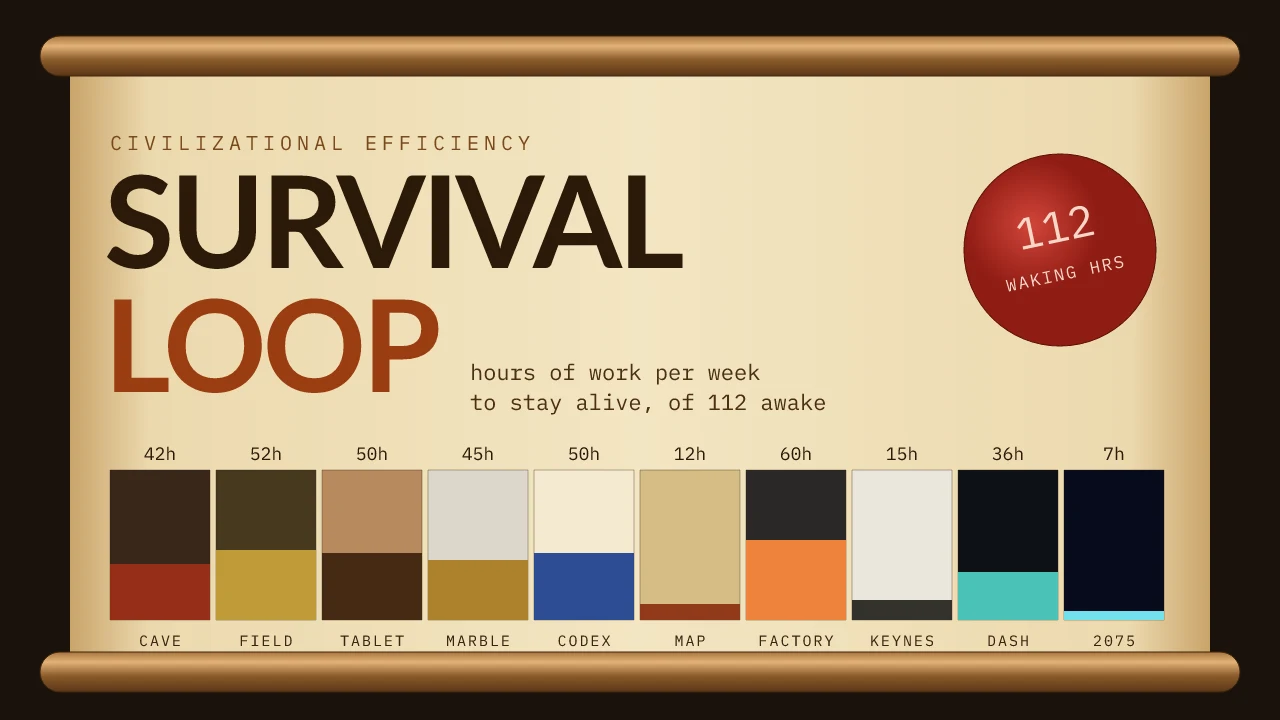
In The Survival Loop we measured a civilization by one ratio: hours of work in, a week of living out. A thinking system needs the same kind of ratio. What goes in, what comes out, what did it cost on the way, and what did we actually want from it?
For agents the first answer is easy to log: tokens. Input tokens (what the agent reads), output tokens (what it writes), and inside those, cached input and private reasoning. But tokens are a currency, not a cost. To compare a machine with a brain you have to go one layer down, to energy, and one layer up, to outcomes.
Jensen Huang, who runs Nvidia, describes AI as a five-layer cake: energy at the bottom, then chips, then infrastructure, then models, then applications on top. He calls energy the binding constraint on how much intelligence the stack can produce. A brain is a five-layer cake too. Put the two side by side and the units line up. Tap a layer.
Carbon
Silicon · after Huang
Five ratios for a thinking system
These are the cognilytics of the built side, each one put next to its biological twin. Some numbers are hard, some are estimates, and one is still blank on purpose.
How much is read per unit written?
A person takes in about a billion bits per second and acts on about ten. Our agents read 184 tokens for every token they write. Same direction, very different scale: the brain throws away almost everything it sees, our agents re-read almost everything they have. measured
How much of the input is actually new?
97% of what our agents read in 30 days was cached text they had seen before. Predictive coding says the brain also forwards mostly surprise, but nobody has a clean percentage. A blank on the carbon side is a research question. measured
What does one bit of output cost?
Our estimate: about 6.7 joules per output token all in, and roughly four bits of information per token of English. That lands in the same order of magnitude as the brain. Treat it as a provocation, not a result: both sides of the ratio are rough, and the brain also runs a body. estimated
How large a task can it carry?
METR's time horizon measures the length of task, in human working time, that an agent finishes half the time. In 2025 it doubled every seven months; 2026 updates report faster. It is the best outcome metric we have, and it is Levin's light cone on a stopwatch. reported
The bottom line.
Tokens are input. A thought is only worth what it changes. The honest final ratio counts outcomes a separate verifier signed off, not outputs the agent claims. For people the matching ratio is hours of attention freed per hour of attention spent steering. proposal
Run the numbers on your own agents
Defaults are our fleet's last 30 days, in millions of tokens. The energy figures per token are our working assumptions, built from Epoch AI's estimate of about 0.3 Wh for a typical 500-token chatbot answer and the usual price ratio between fresh and cached input. Switch between lean, central and heavy to see the range.
The central estimate says our whole fleet, every agent on both of our machines, burned about as much energy in a month as one human brain burns in forty days. Give or take a factor of three. That is the kind of sentence cognilytics should make possible, and it should make us careful: the brain did that while also running a body, keeping a person alive and dreaming at night.
Eight reasons no number is a thought.
Two changes at once: from where to what shape, and from watching to building.
For thirty years brain imaging asked where. Which blob lights up for faces, for fear, for maths. The work in the first half of this manual asks what shape, which state and how compressed. That is a better question, because shape is what a thought does, and it is the same question we ask of artificial networks.
The second change is bigger. Until recently the only way to learn how a mind works was to watch one. Now we can build one, badly, and watch it fail. Each failure tells us what a mind needs. The biological side gives the builders their vocabulary, and the built side gives the biologists their hypotheses. The two halves of this article are converging on one discipline. I would call it consciousness engineering, and cognilytics is its measuring tape.
So here is the proposal, extended. Name the layer, and connect at least two. It works for a brain and for an agent fleet.
A headline that sits on one layer, "this agent used ten million tokens", tells you almost nothing. A result that links two, "this agent kept 97% of its input in cache (I) and still finished a forty-hour task that a verifier accepted (O)", is a real measurement of thinking.
That is where this series goes next, and where it meets The Survival Loop. The hours a society frees up are only worth as much as the thinking that fills them, and soon part of that thinking will run on silicon. Cognilytics is how we will check both.
The whole article as one diagram.
Two columns run in parallel: the biological dive on the left, the built side on the right. Each amber bridge is a mirror from the text. Below the eight layers the columns merge into consciousness engineering and end in one metric. Every box links to its section.
The file.
| Item | Detail |
|---|---|
| Word | Cognilytics = cognitive + analytics. Root *ǵneh₃-, "to know"; Greek ana-lyein, "to untie" |
| Order | Inside out: geometry, compression, states, decoders, encoders, signals, body, clinic. Then the built side: organs, coupling, throughput |
| Fleet data | Portanima Neuroburn, 26 Oct to 25 Nov 2026, measured: 1,936 million tokens, 11,209 calls. Input 1,926 million (cache read 1,868 million), output 10.45 million incl. 3.59 million reasoning |
| Energy estimate | Central: 2 J per output token, 0.2 J per fresh input token, 0.02 J per cached token. Gives about 19 kWh for the month; plausible range about 6 to 60 kWh |
| Bits per token | About 4 bits of information per English token, from Shannon-style estimates near 1 bit per character. Rough |
| Correction | Frontal theta and workload: pooled g = 0.66 (Chikhi et al. 2022), sometimes quoted as 0.68 |
| Preprints | TRIBE v2, Your Brain on ChatGPT, the consciousness indicators report and the METR paper are arXiv preprints, not journal papers |
| Schematics | The geometry demo, compression curves, think-aloud stream, EEG mixer, pupil, coupling dial and cakes are illustrations, not data. The organ table pairs functions by analogy |
| Version | Version 1 published 25 November 2026 (biology). Version 2 the same day: the built side and the flowchart |