 Artificially generated
The Survival Loop
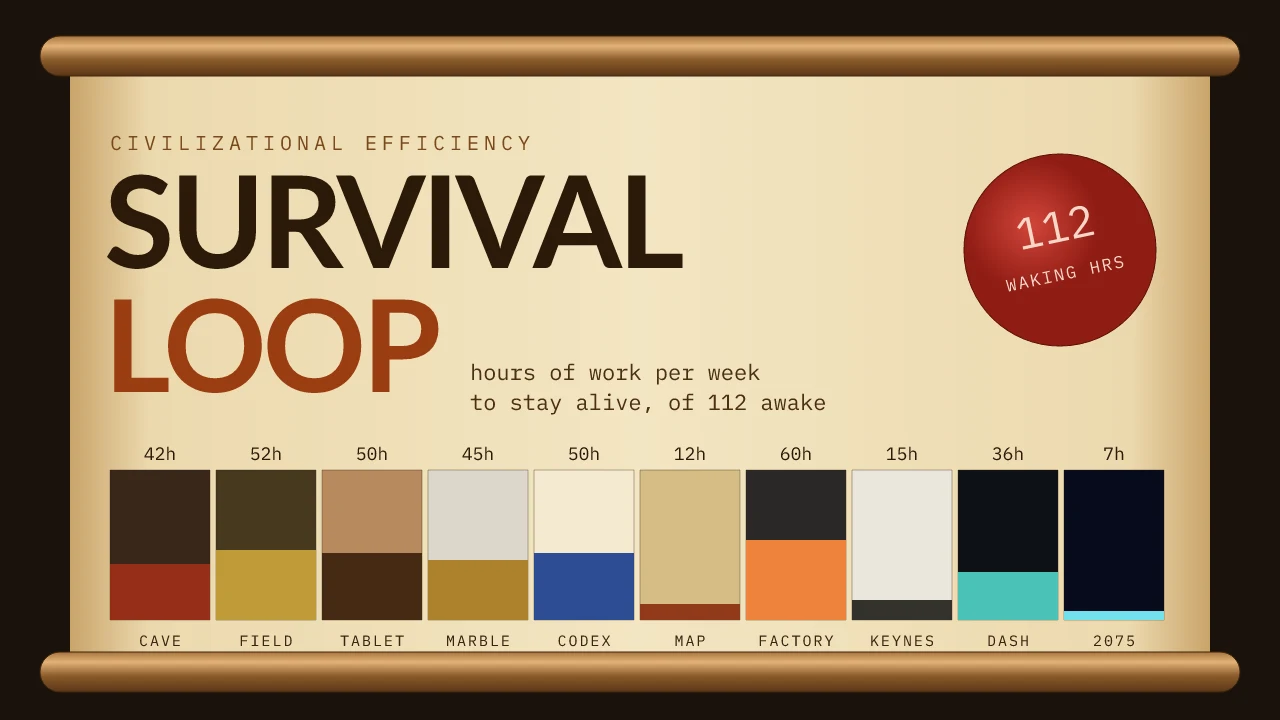
How many hours of work buy one week of staying alive? Ten scenes, from a cave wall to a hologram.
Every life runs two loops. In the survival loop you get food, shelter, warmth and safety. In the leisure loop you live: you play, love, learn, build things nobody ordered. The fewer hours the first loop eats, the more the second one gets. This scroll measures that split across ten thousand years, with real numbers where they exist and labelled estimates where they do not.
One hour in, one week out.
Here is the question that started this scroll. Suppose in one society you put in ten hours of work and you can live for a month. In another you need 160 hours for the same month, and in a third 200. That gap is a very human way to say how efficient a civilization is. Not the only way. One honest way.
We count a week, because a week is the rhythm people actually feel. A person sleeps about eight hours a night, so a week holds 112 waking hours. Every number on this scroll is drawn against those 112 hours. The filled marks are the survival loop. The empty marks are what is left for the leisure loop.
Each number carries a tag, because the evidence gets thin as we walk back: measured someone counted it, derived we calculated it from measured prices and wages, estimated a reasoned guess, contested scholars disagree in public.
Yes. In six dialects, none of them complete.
The bet was right: economists and anthropologists have measured life in hours of work for decades. They just never agreed on one basket, one worker or one name. These are the six families this scroll draws on.
| Dialect | Who | What it counts | What it misses |
|---|---|---|---|
| Time allocation | Richard Lee (1968, 1984), Marshall Sahlins, Mark Dyble (2019) | Hours foragers and farmers spend getting and making food, by direct observation | Bad years, illness, the price of no hospital |
| Welfare ratio | Robert C. Allen and co-authors | A full year of wages divided by the cost of a bare-bones family basket, 1300 to 1900 | Unpaid work, and whether a full year of work was even on offer |
| Labour price of light | William Nordhaus (1997) | Hours of work for 1,000 lumen hours, from a Babylonian lamp to the bulb | One good only |
| Time prices | Cox and Alm, Dallas Fed (1997); Tupy and Pooley, Superabundance (2022) | Minutes of work at the going wage for a chicken, milk, or 50 commodities | Housing and health, the costs that did not fall |
| Food basket in work days | World Vision, Price Shocks, five editions to October 2026 | Ten basic foods priced in hours of local average wage, country by country | Rent, energy, the bottom of the wage scale |
| Monthly Survival Hours | Preprint, 2025 (Preprints.org) | Hours for a frozen essentials basket, including rent, by wage decile in the US | Not peer reviewed yet; one country |
Two and a half days a week.
We cannot clock a Stone Age camp, so we clock the closest living cases. In 1964 the anthropologist Richard Lee spent four weeks counting work in a !Kung camp at Dobe, in the Kalahari. The adults went out for food about two and a half days a week, about six hours a day: 12 to 19 hours a week of getting food. Marshall Sahlins turned this into the famous phrase of the original affluent society.
Then Lee counted again. In 1984 he added what the first count left out: cracking nuts, butchering, making tools, fetching water and wood, keeping the camp. The week grew to 44.5 hours for men and 40.1 for women. Still less than many modern households put into a job plus housework, he noted. Critics added that 1964 may have been a good year for bush food.
In 2019 Mark Dyble and colleagues tracked 359 Agta in the Philippines. Foragers worked about 20 hours a week out of camp. The paint on the cave wall says the same thing as the stopwatch: the loop was short, but not as short as the legend.
The cave count
measured all work, Lee 1984, average of men and women
Farming bought food security. It cost ten hours a week.
Agriculture is the strangest trade in the story. Farming feeds more people per square kilometre, and it stores food against a bad winter. But the people who did it often worked harder for it.
The Agta show the trade in real time, because some of their camps forage and some also grow rice. Dyble's team found that the Agta who mostly farmed worked about 30 hours a week out of camp, ten more than the foragers. Women in the most agricultural camps had half the leisure of women in camps that only foraged.
We take the cave week of 42 hours and add those ten: about 52 hours for a first farmer. That is our estimate, not a record. Nobody kept a timesheet in Çatalhöyük.
The field count
estimated cave week plus the Agta farming gap
Forty-one hours of work for a little light.
The first cities left us something better than a survival basket: a price for a single comfort. The economist William Nordhaus worked out what light cost in human time. In Babylonia around 1750 BC, light came from a sesame oil lamp. By his estimate, 1,000 lumen hours took about 41.5 hours of work. A modern 60 watt bulb gives that much light in under two hours.
Steven Pinker put it in human terms: a Babylonian had to labour about fifty hours to read his clay tablets for one hour by lamplight. The evening, in other words, was a luxury. Most people went to bed with the sun because staying up cost a working week.
For the whole survival loop we have no clean Babylonian wage and basket series, so we estimate about 50 hours: farm labour close to the first fields, plus the extra cost of rations, rent and taxes that came with a city.
The tablet count
estimated whole survival loop
Four days of wages for a measure of wheat.
In AD 301 the emperor Diocletian carved prices into stone across his empire, to fight inflation. The edict gives us both sides of the loop in one place. A farm labourer could be paid at most 25 denarii a day, plus meals. Wheat could cost at most 100 denarii for an army modius, about 17.5 litres.
Our sum: 17.5 litres of wheat weigh about 13.5 kilograms, which is roughly three weeks of bread calories for one adult. Four days of cash wages bought three weeks of grain. That is about 13 hours of work for one week of grain, at a ten hour day.
Grain was not the whole loop. Add oil, wine, salt, cloth, a share of a room, and a family to feed on one wage, and the loop grows to an estimated 45 hours. Two warnings from the stone itself: these were ceilings, not market prices, and the wage came with food on top.
The marble count
estimated whole loop, one adult
The peasant who worked less than you. Probably not.
It is the most shared number in this whole debate. In The Overworked American (1991), Juliet Schor wrote that an adult male peasant in thirteenth century England worked about 1,620 hours a year, fewer than a modern American. Holy days, she argued, ate a third of the calendar.
The number came from an unpublished 1986 working paper by the economist Gregory Clark, which assumed 150 work days per family. Clark later dropped that assumption and put medieval work years at about 250 to 300 days. Schor's own table had a range from about 1,440 to 2,309 hours. And the cooking, spinning, brewing and child care, mostly done by women, had no feast days.
So the honest reading of the manuscript is a range, not a number. We put the medieval loop at about 50 hours a week, all work counted, and mark it contested.
The manuscript count
contested our midpoint, all work
Same century, two worlds: 12 hours or 91.
The economic historian Robert C. Allen built the tool that comes closest to your quotient for the past. He priced a bare-bones basket: the cheapest grain, a little fat, fuel, cloth and rent that keeps a family of four alive. Then he divided a labourer's full year of wages by it. He called the result the welfare ratio.
In the mid 1700s an unskilled labourer in London earned about 4 times that bare-bones basket. A building labourer in Beijing in 1745 to 1754 earned about 0.53 times it: one full year of work bought half a year of bare survival for the family.
Turn this into hours and the map splits. If a work year is 250 days of 10 hours, the London family's survival loop was about 12 hours a week. The Beijing family needed about 91, more than one person can work, so everyone worked: wives, children, spinning at night.
And here is the twist. London labourers did not take their spare 40 hours as leisure. They worked longer and bought sugar, tea, cotton and clocks. The historian Jan de Vries calls it the industrious revolution. Efficiency makes leisure possible. It does not make people choose it.
Sixty hours a week, and a candle cost six.
The industrial revolution raised output per hour like nothing before it. For a long time it did not shorten the week. Around 1800, by Nordhaus's light numbers as Pinker tells them, an Englishman had to work six hours to burn a tallow candle for one hour.
By 1870 the clock had taken over. Michael Huberman and Chris Minns estimate that full-time production workers in the United States put in about 3,096 hours a year, and in the United Kingdom about 2,755. That is about 60 hours a week in the US over a whole year.
These are hours worked, not survival hours, and the difference is the point of this scene. A factory hand could not sell a twelve hour week. The job came in one size. Efficiency went into more cloth, more coal, more people, and later into shorter hours, only after unions fought for them.
The factory count
measured hours worked, US, 1870
A chicken fell from 157 minutes to 14.
In 1997 the Federal Reserve Bank of Dallas printed an annual report that reads like your quotient line by line. W. Michael Cox and Richard Alm priced everyday goods in minutes of work at the average wage of a production worker. The money price of a three pound chicken rose from $1.23 to $3.15. Its time price fell from 2 hours 37 minutes to 14 minutes.
Between those two receipts sits a famous forecast. In 1930 John Maynard Keynes wrote Economic Possibilities for our Grandchildren. He guessed that by 2030 output would be so high that people could live well on three hour shifts, a fifteen hour week. On the food side of the receipt he was too cautious. On the hours side he was wrong, so far.
TIME MARKET · USA
Paid in minutes of work at the average manufacturing wage. Cox and Alm, Dallas Fed, 1997.
One hour or thirty days, on the same planet.
Today the dialects finally speak at once, and they do not agree. World Vision's food basket says the US needs one hour of work, Ireland 1.2, Finland 1.7, while the Central African Republic needs 30.1 days, Malawi 20.4 and Sudan 19.3. Across 56 countries the average was 34.3 hours.
But food is no longer the loop. The Monthly Survival Hours preprint adds rent, utilities and transport. For American renters in the third wage decile, the essentials took 117.4 hours a month in 2019, 175.7 in 2022 and 157.7 in 2025. That is about 36 hours a week: a forager's week, on a phone.
Meanwhile the time price of 50 basic commodities fell 71.6 percent between 1980 and 2018, by the count of Marian Tupy and Gale Pooley. Things got cheap. A roof did not.
Food basket in hours of work, 2026
Days converted at 8 hours, as World Vision does (30.1 days, about 241 hours).
Hours worked per year, OECD 2024
2050: sixteen hours. 2075: seven. If.
Here the scroll stops measuring and starts drawing. The time price of basic commodities fell about 3.3 percent a year from 1980 to 2018 (71.6 percent in 38 years). Apply that rate to the 36 hour survival week of today's low-wage American renter and the loop shrinks to about 16 hours by 2050 and about 7 hours by 2075.
That would be Keynes's fifteen hour week, twenty years late, and then half of it. The if is large. Rent, health care and child care have not followed the commodity curve. Whoever brings housing onto that curve decides whether the future looks like this hologram or like the factory.
There are small signs. In the UK four day week pilot of 2022, 61 companies cut hours without cutting pay; 56 kept going after the trial and 18 made it permanent. Software and machines now do parts of jobs that used to fill whole weeks. The loop can close faster. Whether the hours come back to people is a political choice, not a law of physics.
The hologram count
Survival hours per week and loop ratio. Our arithmetic: 36.4 h × 0.967 per year.
Turn the dial through ten thousand years. Then put in your own week.
Your own loop
The best single number we have. Dangerous when used alone.
The loop ratio has a rare quality: everybody understands it at once. Money changes value, GDP needs a lecture, but an hour is an hour in the Kalahari and in Munich. Prices measured in time cut through inflation, currency and centuries. As a first look at a society, it is excellent. As the only look, it lies in seven ways.
| Trap | What goes wrong | The fix |
|---|---|---|
| Basket drift | Survival in 1750 was oatmeal and a shared room. In 2026 it includes a phone, health insurance and a commute. | Freeze a minimum basket and report it next to a "normal life" basket. |
| Unpaid work | Lee's foragers worked 15 hours or 42, depending on whether cooking counts. | Add unpaid survival hours from time-use surveys. |
| The average hides the bottom | The US food basket costs one hour, the low-wage renter still spends 36 hours a week on essentials. | Report the 20th percentile wage, not the average. |
| Hours come in one size | A London labourer could have lived on 12 hours, but no one hired for 12. | Measure hours worked next to hours needed. The gap is the trap. |
| Rent eats the gains | Food and light fell to minutes. Housing did not follow. | Show the loop by component: food, roof, energy, health, transport. |
| Quality and risk | The forager's 70 free hours came without antibiotics, glasses or a safe birth. | Pair the ratio with healthy life expectancy. |
| Spare time is not free time | People spend efficiency on more things (de Vries) or lose it to commuting and care. | Track the hours people actually get back, not only the hours they could. |
And the deeper reason to care: a civilization is efficient when it hands people their hours back. By that measure we have built miracles on the food shelf and in the light switch, and we are still waiting at the front door of our own homes.
The whole scroll in one table.
| Scene | Survival h / week | Loop ratio | Evidence |
|---|---|---|---|
| Forager, Dobe 1964 | 42 | 2.7 | Measured, Lee 1984 (food only 12 to 19 h, Lee 1968) |
| First farmers | 52 | 2.2 | Estimated from the Agta farming gap, Dyble 2019 |
| Babylonia, 1750 BC | 50 | 2.2 | Estimated; light 41.5 h per 1,000 lumen hours, Nordhaus |
| Rome, AD 301 | 45 | 2.5 | Estimated; grain about 13 h derived from the Price Edict |
| England, 1200s | 50 | 2.2 | Contested; Schor 1,620 h per year vs Clark's revision |
| London, about 1750 | 12 | 9.3 | Derived from welfare ratio 4, Allen; family bare-bones basket |
| Beijing, 1745 to 1754 | 91 | 1.2 | Derived from welfare ratio 0.53, Allen et al. 2011 |
| US factory, 1870 | 60 worked | 1.9 | Measured hours worked, Huberman and Minns |
| US low-wage renter, 2025 | 36 | 3.1 | Derived from 157.7 h per month, MSH preprint |
| Keynes, for 2030 | 15 | 7.5 | Forecast written in 1930 |
| Trend, 2050 / 2075 | 16 / 7 | 6.8 / 15.6 | Projection at the 1980 to 2018 commodity time price trend |
- Lee, "What Hunters Do for a Living" (Man the Hunter, 1968), and the 1984 revisionThe 12 to 19 hour week and the later 40 to 44 hours, summarised with critique.https://en.wikipedia.org/wiki/Original_affluent_society
- Kaplan, The Darker Side of the "Original Affluent Society" (2000)Lee 1984 figures for men and women, and the case against the legend.https://gwern.net/doc/sociology/2000-kaplan.pdf
- Dyble et al., Nature Human Behaviour (2019)Agta foragers vs farmers: about 20 vs 30 hours of out-of-camp work a week.https://www.nature.com/articles/s41562-019-0614-6
- Nordhaus on the price of light, via CORE EconBabylonian sesame lamp to modern bulb in hours of work.https://books.core-econ.org/the-economy-v1/book/text/01.html
- Edict on Maximum Prices, AD 301, English translationFarm labourer 25 denarii with maintenance; wheat 100 denarii per army modius.https://kark.uib.no/antikk/dias/priceedict.pdf
- The Myth of the Comfortable Peasant, Liberal CurrentsWhere Schor's 1,620 hours came from and why it does not hold.https://www.liberalcurrents.com/the-myth-of-the-comfortable-peasant/
- Allen, The British Industrial Revolution in Global PerspectiveWelfare ratios: London and Amsterdam near 4 against Delhi and Beijing near 1.https://users.nber.org/~confer/2006/SEGs06/allen.pdf
- Allen, Bassino, Ma, Moll-Murata, van Zanden (2011)Wages, prices and living standards in China 1738 to 1925; Beijing ratio 0.53.https://eprints.lse.ac.uk/32403/1/Ma_Wages-prices-living-standards-China-1738-1925_2011.pdf
- Huberman and Minns, Days and hours of work, 1870 to 2000Annual hours of full-time workers in the Old and New Worlds.https://ourworldindata.org/grapher/annual-working-hours-per-worker
- Cox and Alm, Time Well Spent, Dallas Fed Annual Report 1997Work time for a chicken, milk, oranges and beef, 1919 to 1997.https://fraser.stlouisfed.org/title/annual-report-federal-reserve-bank-dallas-475/1997-annual-report-596521/fulltext
- World Vision, Price ShocksA ten-food basket in hours of work across countries. October 2026 edition reported by Church Times.https://www.churchtimes.co.uk/articles/2026/30-october/news/world/cost-of-basic-food-equals-a-month-s-wages-in-some-countries
- Affordability in Hours: Monthly Survival Hours (preprint, 2025)Essentials basket in hours by US wage decile, 2019 to 2025.https://www.preprints.org/manuscript/202510.1728
- OECD, Average annual hours actually worked per worker2024: Mexico 2,215, United States 1,796, Germany 1,334.https://data-explorer.oecd.org/
- Tupy and Pooley, Superabundance (Cato)Time price of 50 basic commodities down 71.6 percent, 1980 to 2018.https://www.cato.org/publications/superabundance-free-exchange
- Keynes, Economic Possibilities for our Grandchildren (1930)The fifteen hour week, forecast for 2030.https://en.wikipedia.org/wiki/Economic_Possibilities_for_our_Grandchildren
Cut-off: 25 November 2026. Survival hours per week count one adult unless a scene says family. Tags: measured means someone counted it; derived means our arithmetic on measured prices and wages (London and Beijing assume a work year of 250 days of 10 hours; Rome assumes 13.5 kg per army modius and 2,200 kcal a day); estimated and projection are our reasoned numbers and should be read as such. The cave hands, tablet wedges, coins, map and hologram are drawn for this article.