 Artificially generated
Disney synergy sketches 1957 and 1967: films at the center, then the parks move in
Two production drawings, ten years, one dead founder in between. The first puts Theatrical Films at the hub. The second has Disneyland, WED, and a Florida that does not yet exist rearrange the company.
The Disney synergy sketches of 1957 and 1967 are the most readable corporate strategy the twentieth century put on a single sheet. Finished studio drawings with Mickeys running along the arrows, and verbs instead of consulting language: feeds, plugs, promotes, exploits. Read the two sheets in order and you watch a film studio become a park company before Walt Disney World had built a single attraction. Acquired.fm told that company history in 2026 across two episodes of four and a half hours each.
A company that draws itself as a cartoon.
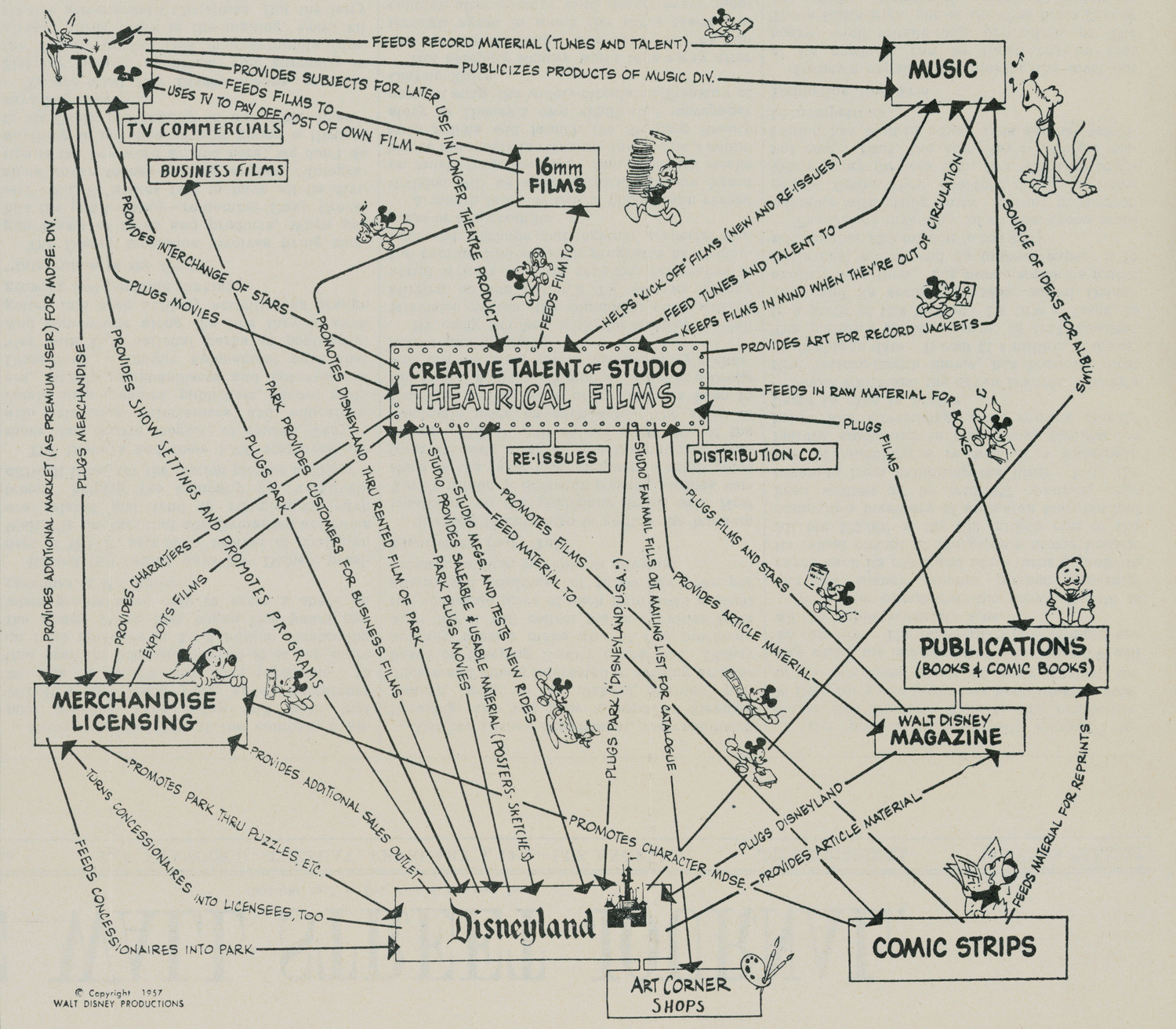
Most firms write strategy in sentences nobody quotes. Disney built it, in 1957 and again in 1967, as a picture: boxes, arrows, and characters walking the arrows. Each Mickey carries something that belongs to the destination box. A record to Music. A newspaper to Comic Strips. Skis to Mineral King. The figures are the map legend.
Todd Zenger pulled the 1957 drawing from the Disney Archives for the Harvard Business Review in 2013 and wrote that it depicts a central film asset infusing value into related entertainment assets and being supported by them in return. The auction listing for the 1967 sheet calls the same kind of page an organizational synergy diagram: an original print, 14 by 11 inches, Disney file number 767-8 in pencil on the back, photographic print on paper, not a reprint. Cartoon Brew put it in public in 2012 when Howard Lowery auctioned the print.
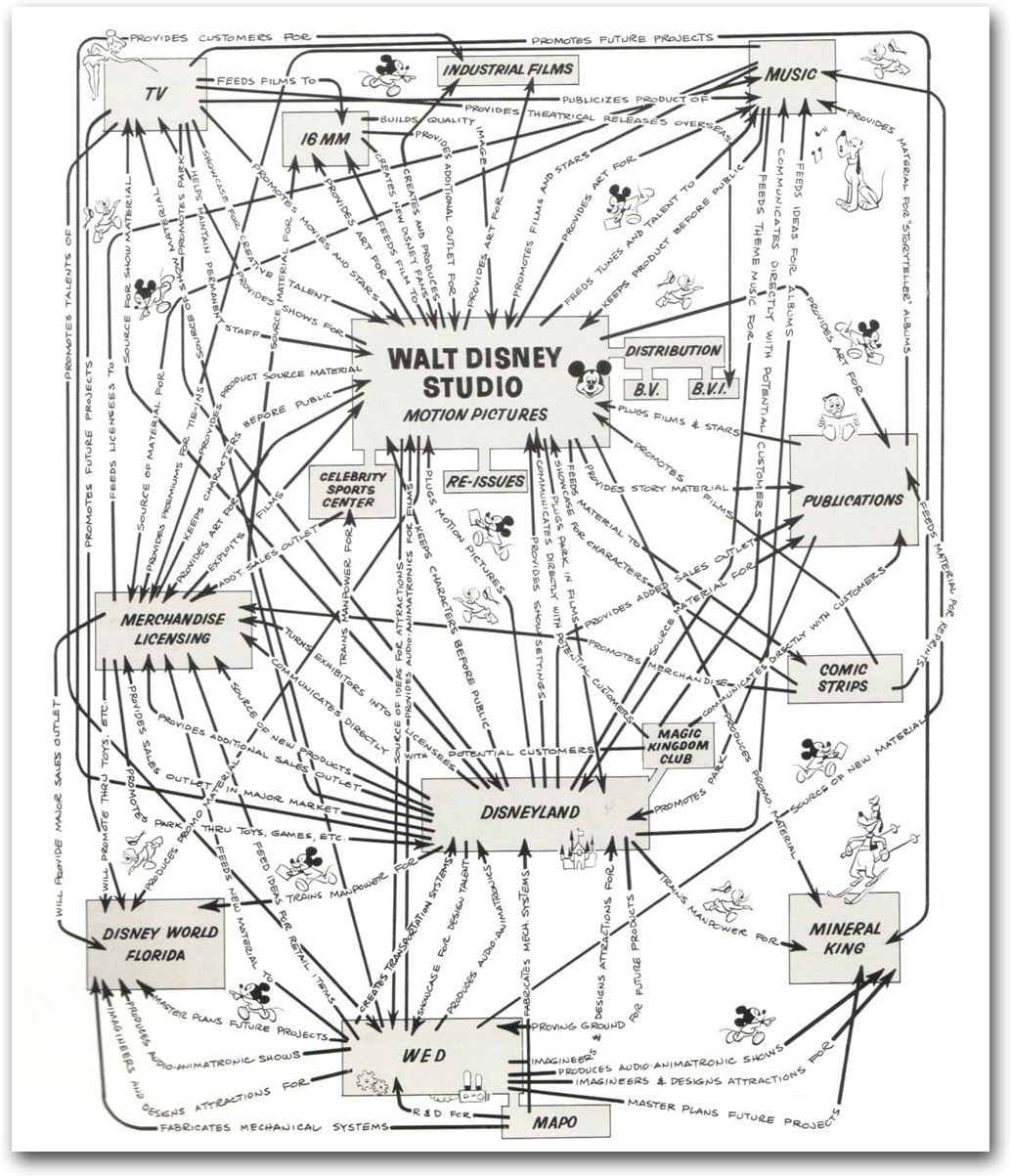
Between the two sheets sits Walt's death on 15 December 1966. The second drawing is the company as he left it, plus what was already in motion and not yet standing: Disney World Florida, which opens only in 1971. Mineral King, a planned ski resort in the Sierra Nevada that was never built. WED, the shop that later becomes Imagineering. MAPO, the animatronics unit whose name comes from the profits of Mary Poppins.
Theatrical Films. Everything else hangs off that box.
Copyright 1957 Walt Disney Productions
The center is not Walt and not Mickey. It is a sentence in a box that looks like a shop sign: Creative Talent of Studio, Theatrical Films. Under it, Re-issues and Distribution Co. From there the arrows run every direction, and almost every arrow also runs back.
TV uses films to pay off the cost of its own film, feeds subjects for later theatrical product, and publicizes the music division. Music gets tunes and talent from the studio, sends art for record jackets back, and keeps films in mind when they are out of circulation. Publications take raw material into books and comics. Comic strips feed material for reprints. The magazine plugs Disneyland. Merchandise licensing plugs movies, supplies additional markets, and turns concessionaires into licensees. Disneyland exploits films, plugs movies, tests new rides, and is an additional sales outlet.
The sheet does not know the word synergy. It knows verbs. Feed, plug, promote, exploit, publicize. Anyone who says flywheel today is naming the same loop with a word the Wall Street Journal used for Disney in 1958. Acquired linked that WSJ piece as an artifact in the June 2026 episode.
What is still small in 1957: Disneyland sits at the bottom, with Art Corner Shops as an appendage. The park is two years old. It is a node, not the hub.
Same idea, denser net, a park that does not exist yet.
Copyright 1967 Walt Disney Productions
The center box now reads Walt Disney Studio, Motion Pictures, with a Mickey head beside it. Disneyland has moved up, almost level with the studio. Under it, boxes that did not exist in 1957: WED. MAPO. Disney World Florida. Mineral King, with a skiing Goofy. Celebrity Sports Center. Magic Kingdom Club.
WED is the shop. Walt kept it private until 1965, which is why it is missing from the 1957 company drawing. John Gruber added that in 2023, the first time he had seen the 1967 sheet: Disney was, and should remain, a serious engineering company. MAPO fabricates mechanical systems and audio-animatronics. The name comes from Mary Poppins profits. The unit was dissolved in 2012. Disney World Florida receives master plans, audio-animatronic shows, attractions. The park opens on 1 October 1971, four years after this sheet, five after Walt's death.
Mineral King is the box the future did not keep. A planned ski resort in Sequoia country, Sierra Nevada. The Sierra Club sued. The project is dead by 1978. On the 1967 drawing Goofy is already skiing there, as if the slope existed. Celebrity Sports Center in Denver closes in 1994. Not every box on a synergy map outlives the map.
Box by box, what arrived in ten years and what slid off.
- Center1957: Creative Talent of Studio / Theatrical Films. 1967: Walt Disney Studio / Motion Pictures. Same core, different letterhead. Film stays the source. The park becomes the neighbor.
- Disneyland1957 at the bottom, one node among many. 1967 closer to the middle, with its own arrows to WED, Florida, merchandise, TV. Gruber: parks eventually replace movies as the economic hub. The 1967 drawing shows the start of that shift, not the end.
- WEDInvisible in 1957 because it was private. Sold into the company in 1965. Own box in 1967: Imagineers, audio-animatronics, master plans for Florida and Mineral King.
- MAPONew in 1967. Factory for mechanical systems. Money from Mary Poppins. Dissolved 2012. A box with an expiry date the drawing does not know.
- FloridaNew in 1967, four years before opening. The sheet treats a park that is still swamp as if it were already a node in the net.
- Mineral KingNew in 1967, never built. The map therefore also contains projects the company wanted and an environmental suit stopped.
- TVAlready large in 1957, because Disneyland was financed through ABC. Larger still in 1967, with Industrial Films and 16mm as their own boxes. The anthology show remains the pipe into American living rooms.
- DistributionA Co. in 1957. B.V. and B.V.I. in 1967, Buena Vista. The company distributes itself.
- Art Corner / magazineOwn boxes in 1957. Absorbed or renamed by 1967. The idea stays. The labels change.
Read as before and after, the two sheets give you a thesis Acquired pours into numbers in 2026: the company that began as a moonshot film studio later makes its reliable money in parks, ships, hotels. Film stays the culture engine. The park becomes the till. 1967 already has that on paper, in the placement of the boxes, not in a sentence.
Walt did not draw this on a napkin. Not this sheet, anyway.
Online, the 1957 drawing is often called a napkin sketch. Reforge, NextShark, a few dozen LinkedIn posts: Walt drew the business model on a napkin, and an empire followed. The sheet we have is not a napkin scribble. It has typeset boxes, a copyright line, repeating character art, arrow labels in a hand that had practice. Zenger writes that the archives hold several versions of this theory, which evolved over time. That sounds like studio work, not lunch.
Whether Walt himself pulled the lines is not written on either sheet. Folklore says yes. The evidence says Walt Disney Productions, 1957 and 1967. A company that draws itself, with a department that does that all day. We leave authorship open and name the napkin for what it is: a rumor that travels farther than a production drawing.
The Disney Archives exist. Zenger saw 1957 there. A free archive scan of these two sheets is not on offer. What circulates are reproductions: Flickr, Cartoon Brew, HBR. The pictures in this article come from there, not from a Disney download button.
A 14-inch print at 300 dpi would be about 4200 pixels wide. Disney has that, or the buyer of the Howard Lowery sheet. Not the open web, not this article.
Two nights for the firm history, plus five older episodes for the acquisitions.
Ben Gilbert and David Rosenthal told Disney in 2026 as a series, not as a deal episode. Part 1 is Walt's era and the invention of the flywheel. Part 2 is the company after Walt: Eisner, the vault, ESPN, Iger, Pixar, Marvel, Lucasfilm, streaming. The older Acquired episodes from 2015 to 2019 stay up. They are the individual purchases. If you want to read the sketches, start with the two long ones. Transcripts sit on the episode pages. Companion PDFs sit in the Acquired library. We link both in full, not as a teaser.
Acquired calls Disney the most successful enterprise ever created for monetizing human nostalgia. In Walt's era it was the opposite of a reliable compounder: a moonshot factory that nearly wrecked itself on a feature-length cartoon (Snow White) and on a park born of a model-train obsession (Disneyland, 1955). Oswald the Lucky Rabbit goes to Universal. Mickey and Steamboat Willie replace him. Kay Kamen builds merchandising from 1932. Television pays for the park: the ABC anthology series is not a side hustle, it is the campaign that makes Disneyland affordable. The 1957 drawing is that loop on paper. Acquired links the 1958 WSJ flywheel article as an artifact, and Neal Gabler's biography as a main source.
In 1984 the company is worth more dead than alive. Corporate raiders want to sell the film library to MGM and the parks to hotel operators. Instead Michael Eisner, Frank Wells, and Jeffrey Katzenberg arrive. Animation wakes up: The Little Mermaid 1989, Beauty and the Beast 1991, Aladdin, The Lion King 1994. The vault comes home on VHS and later DVD. Broadway, especially The Lion King, becomes its own till. In 1995 Disney buys Capital Cities/ABC and gets ESPN with it. Acquired calls that the greatest media acquisition of all time, and one nobody planned as the core. Then it almost falls apart again: Euro Disney, the board war, Roy E. Disney and SaveDisney, the Comcast hostile bid in 2004. Bob Iger buys Pixar in 2006, Marvel in 2009, Lucasfilm in 2012. BAMTech becomes the streaming shop, Disney+ launches in 2019, Fox comes in, COVID and Bob Chapek, Iger returns. The thesis at the end: parks carry the reliable money, streaming is the fight with the tech companies, film remains the culture engine from the 1957 sketch, only with more boxes.
The older episodes: the same boxes, as acquisitions
Before the two long episodes, Acquired told Disney in pieces. The playlist sits at acquired.fm/series/disney. Each episode has a transcript jump on the episode page. Library companion PDFs are reliable for the 2026 pair, not always for the older ones.
- Pixar · 15 Oct 2015Acquired episode 1. Steve Jobs, Toy Story, the break with Eisner, the 2006 purchase. The animation that still sat inside the studio box in 1967 comes back into the house as its own culture. Episode · Transcript
- Lucasfilm · 19 Jan 2016$4 billion, 2012, right after The Force Awakens hit theaters. In this episode Ben and David already show Walt's flywheel diagram, the 1957 drawing. Episode · Transcript
- BAMTech · 10 May 2017Major League Baseball builds a streaming company. Disney buys in as a minority in 2016. That box later becomes the technical side of Disney+. 1 hour 20. Episode · Transcript
- ESPN · 20 Jan 2019From a failed weatherman to a sports-rights machine in Bristol, Connecticut, via Getty Oil and Berkshire, into Disney's hands through the ABC deal. The box nobody would have drawn on the 1967 synergy map. Episode · Transcript
- Disney, Plus · 25 Nov 2019Iger gives up Netflix money and pay-TV cashflow to own, for the first time in company history, a direct pipe to the customer. The flywheel sketch as the argument for why Disney has to do this, and as the risk for why it might fail. Episode · Transcript
The series in one sentence: in 1957 everything hangs off the film. In 1967 parks and engineering move in. In 1995 television arrives as an accidental till. From 2006 to 2012 foreign flywheels are bought (Pixar, Marvel, Lucasfilm). In 2019 the company tries to own the last missing arrow itself, the one into the living room, without ABC and without Netflix. The sketches stop in 1967. The episodes tell you which boxes arrived after, and which, like Mineral King, vanished again.
| Claim | Bin | From where |
|---|---|---|
| Both sheets are Disney production drawings, © 1957 and 1967 Walt Disney Productions | Fact | Copyright line on the drawings themselves. |
| The 1957 sheet sits in the Disney Archives | Second-hand fact | Todd Zenger, HBR June 2013. We have not been in the archive. |
| Walt drew this on a napkin | Folklore | Blog and LinkedIn transmission. The sheet in front of us is a finished studio drawing. Hand authorship: unproven. |
| 1967 original print 14 × 11 inches, file 767-8 | Auction fact | Howard Lowery, quoted by Cartoon Brew, 8 September 2012. |
| Official high-res archive scans for download | Not found | Search 27 August 2026: Disney Archives, D23, Family Museum, Flickr original, auction houses. Largest public repros: 1500 × 1313 (1957) and 1120 × 1288 before crop (1967). |
| WED was Walt's private firm until 1965, hence missing in 1957 | Fact | Retlaw / WED history, added by Gruber as an update in 2023. |
| Mineral King was never built | Fact | Sierra Club litigation, project abandoned 1978. |
| MAPO comes from Mary Poppins, dissolved 2012 | Fact | Open Culture / MAPO company history. |
| Parks replace film as the economic hub | Thesis | Gruber 2023, Acquired 2026, Disney's later segment numbers. The 1967 drawing shows the direction, not the end state. |
| Acquired transcripts and companion PDFs are fully public | Fact of the pages | acquired.fm episode #transcript, library.acquired.fm PDFs for the 2026 pair. As of 27 August 2026. |
| McGrinsey owns these images | No | Editorial, cited. Rights stay with Disney. |
- Todd Zenger, What Is the Theory of Your Firm?HBR, June 2013. 1957 drawing from the Disney Archives, film as the core asset.https://hbr.org/2013/06/what-is-the-theory-of-your-firm
- Cartoon Brew, Organizational Synergy Diagram 19678 September 2012. Howard Lowery auction, 14 × 11 inches, file 767-8.https://www.cartoonbrew.com/disney/walt-disney-productions-organizational-synergy-diagram-1967-69533.html
- John Gruber, Walt Disney’s Mid-Century Business Strategy ChartsDaring Fireball, 17 August 2023. Parks move in, WED missing in 1957 because private, Mineral King.https://daringfireball.net/2023/08/disney_strategy_charts
- Acquired, The Walt Disney Company21 June 2026, 4 h 31. Flywheel, Walt's era. Transcript and companion PDF.https://www.acquired.fm/episodes/the-walt-disney-company#transcript
- Acquired, Disney: The Renaissance and the Empire9 August 2026, 4 h 32. Eisner through Iger. Transcript and companion PDF.https://www.acquired.fm/episodes/disney-the-renaissance-and-the-empire#transcript
- Acquired, Disney playlistPixar, Lucasfilm, BAMTech, ESPN, Disney Plus, plus the two long episodes.https://www.acquired.fm/series/disney
- WSJ, Disney flywheel 1958The newspaper piece Acquired treats as the origin of the flywheel word for Disney.https://i.a.dj.com/pubedit/WSJ.Disney.1958 (2).pdf
- Kottke, Walt Disney’s corporate strategy chartJune 2015. One of the places the 1957 drawing entered the open web.https://kottke.org/15/06/walt-disneys-corporate-strategy-chart
- Open Culture, 1967 Map of the Disney Entertainment Empire8 January 2020. MAPO, Celebrity Sports Center, 16mm.https://www.openculture.com/2020/01/a-map-of-the-disney-entertainment-empire.html
- Acquired companion PDF, part 1Timelines, explainers, visuals for Walt's era.https://library.acquired.fm/episodes/the-walt-disney-company.pdf
- Acquired companion PDF, part 2Renaissance, empire, artifacts (Pixar, SaveDisney, Roy's letter).https://library.acquired.fm/episodes/disney-the-renaissance-and-the-empire.pdf
Cut-off: 27 August 2026. Written with the McGrinsey writing skill. The drawings stay Disney's. The reading is ours.