 Artificially generated
Who the Heaven was Jacob Lorhard?
Eight arts, drawn as trees a student could hold, and a word on the 1606 title that is still the word we use.
Jacob Lorhard (Latin Jacobus Lorhardus) was born in 1561 in Münsingen, in the Duchy of Württemberg, and died on 19 May 1609. From 1603 he was rector of the gymnasium in St. Gallen. In 1606 Georg Straub printed his schoolbook there, Ogdoas Scholastica. The title gives metaphysics a second name: ontologia.
A page a boy can point at.
The heaven is a schoolbook. What he left is a stack of trees. Grammar, logic, rhetoric, the sky, ethics, physics, and at the end the art he gave two names. A student gets a sheet he can follow with a finger.
Barry Smith counted the 1606 volume in 2022. Apart from the title page, the epigrams and the list of errata, the book is diagrams: some 198 of them. Eight books, one town printer, Georg Straub, and a rector who thought an art was something you could hold. The warm room is the gymnasium, and the page on the desk.
Ogdoas means eight. He printed eight.
Ogdoas Scholastica, continens Diagraphen Typicam artium. A scholastic set of eight, containing a typical diagram of the arts. The title then names them, in this order.
| Art on the 1606 title | What the boy was learning | |
|---|---|---|
| 1 | Grammatices Latinae | Latin grammar |
| 2 | Grammatices Graecae | Greek grammar |
| 3 | Logices | Logic |
| 4 | Rhetorices | Rhetoric |
| 5 | Astronomices | Astronomy |
| 6 | Ethices | Ethics |
| 7 | Physices | Physics |
| 8 | Metaphysices, seu Ontologiae | Metaphysics, or ontology |
Book 8 is the one the word sits on. Sara L. Uckelman translated it in 2008 for the Institute for Logic, Language and Computation in Amsterdam. The opening definition, in plain words, is this. Metaphysics, which he also calls ontology, is knowledge of an intelligible by which that intelligible is intelligible: known by a person, through the natural light of reason, with no conception of matter in the knowing. The parts are two. One of them is the universal, which consists of intelligibles and beings.
He splits the intelligibles into universals and particulars. Universals split again, into basic objects and attributes. The attributes he calls most common are existence and duration: that a thing is, and how long. He uses a real thing against three neighbours: the rational, the imaginary, the merely verbal. Beings that belong to the world outside a mind do not wait for the mind. Beings of reason live in the talking. Whenever you sort the world, he wants you to sort the words you sorted it with.
Uckelman notes a printer's slip in the Greek gloss: the first word is misspelt. The Latin is the sentence the class was meant to learn.
The sheet below is plate A of that same 1606 printing: the grammar tree, etymologia, art 1. Straub, St. Gallen. The ontology tree is book 8. Raul Corazzon has put that diagraph on ontology.co, next to a translation. The whole Latin volume is the Google scan of the copy the English Wikipedia points at, books.google.com/books?id=EIvc1kak6xEC.
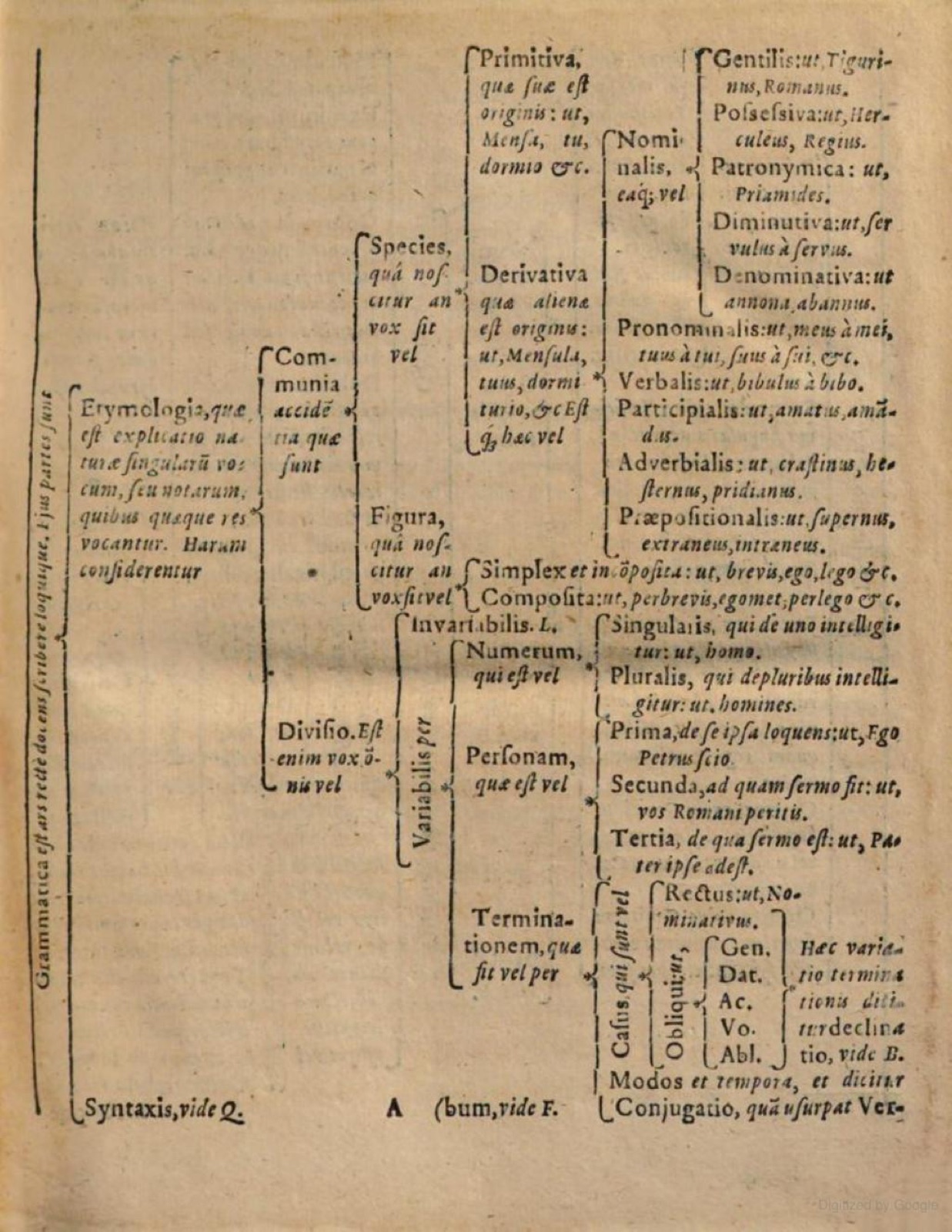
Ogdoas Scholastica, Georg Straub, St. Gallen, 1606. Plate A is the grammar tree. Book 8 is the ontology.
Existence, and how long it lasts.
The feeling in the book is confidence. He calls human rationality the natural light of reason, and he writes as if that light finds one order, the order that is already in the world. A boy in St. Gallen can be shown it. The showing is the drawing.
The attributes he calls most common are existence and duration. Book 8 still closes under God, finis ontologiae, with God. The top of the tree, the place a student meets first, is "that it is" and "how long". The world is readable. The reading begins with something being there, and with the length of time it lasts.
The job he went back to was the school.
He studied at Tübingen. The early printed disputes sit there: a disputation on the constitution of actions in 1591, propositions on the real presence of the body and blood of Christ in the supper in 1592, a book on reaching a necessary, demonstrative truth in 1597, Liber de adeptione veri necessarii seu apodictici. The method disputation, Disputatio de vera et Aristotelica methodo demonstrandi, is printed under his name with a defender named Georg Johannes Peplis. One catalogue says 1592. The bibliographies say 1595, Gruppenbach, OCLC 245988900. The German Wikipedia's biography line says he took his degree with that text in 1592. The sheet and the catalogue do not share a year. Both years are in the record.
In 1603 the gymnasium in St. Gallen made him rector. The care from then on is the eight arts, drawn so a class can walk them. The diagram method is Peter Ramus's. Ramus, born 1515, killed in the St Bartholomew's Day massacre in 1572, had turned dialectic into one pedagogical method and drawn it. Lorhard follows that method. He believes a student understands an ontological truth better when the truth is a tree. Thirty-four years after Ramus died, a Swiss schoolbook is still teaching by his brackets, and it has a new word on the last bracket.
In 1607 Landgrave Moritz of Hesse-Kassel offered him a theology chair at Marburg. Rudolph Göckel, the Goclenius of the later lexicon, was already professor there in logic, ethics and mathematics. The English Wikipedia says the two men probably met. The stay was short. Lorhard went back to the gymnasium. The chair he kept was the one with the boys and the trees.
Timpler had the system. Lorhard had the word.
Two years before the Ogdoas, Clemens Timpler published Metaphysicae systema methodicum at Steinfurt, in 1604. Lorhard follows him. The subject of the art is the intelligible. Ens, a being, is the word Goclenius will later put in the lexicon. Marco Lamanna's correspondence between the two books is linked from ontology.co. The schoolbook is Timpler's metaphysics drawn as brackets a class can read. The neologism on the title is Lorhard's.
A rector took a system a colleague had printed and redrew it for a gymnasium, then named it in a way Timpler's title had not. The debt is real. The word is his.
He died on 19 May 1609. Born in 1561, so he was 47 or 48. Four years later a second edition came out in Basel, from Waldkirch, under a new title, Theatrum philosophicum. It is larger. Hebrew joins the grammars. Arithmetic, geometry and music come in. The word ontologia is off the front of the book. It is still inside, on the metaphysics. OCLC 186897020.
The same year, Goclenius printed Lexicon philosophicum. Page 16 gives the new word one line: "ontologia, philosophia de ente." Ontology, the philosophy of being. The schoolbook had defined the art as knowledge of the intelligible. The dictionary defined the word as the philosophy of being. History kept the dictionary.
He named the science of being, then taught a different subject.
The Greek parts of the word he coined announce an account of being. Book 8 teaches knowledge of an intelligible as intelligible, by the natural light, with matter left out of the conception. He stood crosswise to the word in the same year he printed it.
The price arrives after he is dead, and it is specific. In 1613 the front of Theatrum philosophicum drops ontologia. In 1613 the lexicon on the desk defines the word as the philosophy of being, the definition he had stepped away from. The trees stayed in the school. The sentence that travelled was Goclenius's.
The grammar tree is still a tree. The word is still in use.
Plate A, above, is where he began the book: language, etymologia, the brackets for simple and compound, for case, mood and tense. A rector who wants boys to see the world starts them on the words they already speak. Book 8 is the same hand, later in the volume, with the word on the header: Metaphysicae seu ontologiae diagraphe. Smith finds the word a third time at the close, finis ontologiae.
The word walked out of St. Gallen. It is the word on four pieces in this magazine. The German one carries a 23-minute recording, Ontologie: vier Primitive, titled "Von Aristoteles zu Palantirs KI-Agenten". The English text of that piece is Ontology: four primitives. Palantir's McGrinsey Ratio in it is 132. The jobs that sit on the same idea are 100 neue KI-Berufe and 100 new AI jobs.
Lorhard's heaven was that room: a town printer in St. Gallen, a page a student could hold, a second name for metaphysics. Goclenius's lexicon then defined the word as the philosophy of being. Plate A is still the grammar tree from 1606. The word on that title is the word on the pieces linked above.
The method of this portrait is Who the Heaven.
| Claim | Basket | Where it comes from |
|---|---|---|
| Born 1561 in Münsingen, Duchy of Württemberg (the German town). Died 19 May 1609. Rector of the gymnasium in St. Gallen from 1603. Studied at Tübingen. | Fakt | English Wikipedia, Jacob Lorhard. German Wikipedia, Jacob Lorhard. GND 119746832. |
| Ogdoas Scholastica, Georg Straub, St. Gallen, 1606. Eight arts, the last named Metaphysices, seu Ontologiae. OCLC 41227134. | Fakt | The book. English and German Wikipedia. Google scan, id EIvc1kak6xEC. |
| Apart from title page, epigrams and errata, the 1606 book is diagrams. Smith counts some 198. The word ontologia appears on the main title, on the book 8 header, and at the close, finis ontologiae. | Fakt | Barry Smith, The Birth of Ontology, 2022, pp. 57 to 66. philarchive.org/archive/AUGTBO-2. |
| Book 8 treats metaphysics, or ontology, as knowledge of an intelligible by which it is intelligible, by the natural light of reason, without a conception of matter. Most common attributes: existence and duration. | Fakt | Sara L. Uckelman, Diagraph of Metaphysic or Ontology, ILLC X-2008-04, translating book 8. English Wikipedia for the attribute line and the real, rational, imaginary, verbal split. |
| That 1606 printing is the first published use of ontologia. Smith says almost certainly. Øhrstrøm, Schärfe and Uckelman state it as the first use. | Hypothese | Smith 2022. Øhrstrøm, Schärfe, Uckelman, Jacob Lorhard's Ontology, ICCS 2008, Springer, pp. 74 to 87. |
| Clemens Timpler, Metaphysicae systema methodicum, Steinfurt, 1604. Lorhard follows him. The subject is the intelligible. The diagrams are the school form. The word on the title is Lorhard's. | Fakt | English Wikipedia. Raul Corazzon, ontology.co/jacob-lorhard.htm, linking Marco Lamanna's correspondence between Timpler and Lorhard. |
| 1607: Landgrave Moritz of Hesse-Kassel offers a theology chair at Marburg. The stay is short. Lorhard returns to the gymnasium in St. Gallen. Goclenius is already professor there of logic, ethics and mathematics. | Fakt | English Wikipedia, Jacob Lorhard. |
| Lorhard and Goclenius met in 1607 and compared views. | Hypothese | English Wikipedia says they probably met one or several times. |
| 1613, Basel, Waldkirch: Theatrum philosophicum, second edition. Adds Hebrew, arithmetic, geometry, music. Ontologia leaves the front and stays inside. OCLC 186897020. Same year, Goclenius, Lexicon philosophicum, p. 16: ontologia, philosophia de ente. | Fakt | English Wikipedia. ontology.co for Waldkirch and the expanded title. |
| Tübingen prints before the Ogdoas: Disputatio de systasei actionum, Gruppenbach, 1591. Propositiones on the real presence, 1592. Liber de adeptione veri necessarii seu apodictici, 1597, OCLC 22740196. The method disputation names Georg Johannes Peplis as defender. ontology.co dates it 1592. Both Wikipedias list a 1595 Gruppenbach edition, OCLC 245988900. The German biography line says the degree was 1592. | Fakt | ontology.co. English Wikipedia works list. German Wikipedia, body and works list. |
| The Tübingen years overlap Johannes Kepler, about ten years younger: Kepler was there from 1589 until he left for Graz in 1594. The German Wikipedia says the young lecturer taught him. | Hypothese | German Wikipedia, one sentence. Kepler's mathematics teacher at Tübingen is Michael Maestlin. The overlap of the years is the firmer half of the row. |
| The diagram method begins with Lorhard. | Gerücht | German Wikipedia states it. Peter Ramus had already made dialectic a method you draw. English Wikipedia and the Øhrstrøm line put Lorhard in that tradition, not at the start of it. |
- Ogdoas Scholastica, 1606Jacob Lorhard, St. Gallen, Georg Straub. Latin text. The grammar plate in this piece is plate A of this scan.https://books.google.com/books?id=EIvc1kak6xEC
- Sara L. Uckelman, 2008Diagraph of Metaphysic or Ontology. English of book 8. ILLC X-2008-04.https://eprints.illc.uva.nl/668/1/X-2008-04.text.pdf
- Barry Smith, 2022The Birth of Ontology. Some 198 diagrams. Almost certainly the first published ontologia. Pages 57 to 66.https://philarchive.org/archive/AUGTBO-2
- Øhrstrøm, Schärfe, Uckelman, 2008Jacob Lorhard's Ontology: a 17th century hypertext. ICCS 2008, Springer, pp. 74 to 87. ILLC PP-2008-20.https://eprints.illc.uva.nl/294/1/PP-2008-20.text.pdf
- Raul Corazzon, ontology.coWorks list, the 1592 defender line, the diagraph of ontologia, Lamanna's Timpler correspondence.https://www.ontology.co/jacob-lorhard.htm
- English WikipediaLife, the Marburg offer, the 1613 title, Goclenius page 16, the Ramus line.https://en.wikipedia.org/wiki/Jacob_Lorhard
- German WikipediaThe 1592 degree line, the Kepler sentence, the diagram-method sentence filed above as Gerücht.https://de.wikipedia.org/wiki/Jacob_Lorhard
- On this magazineThe German ontology piece, with the recording. The English text. The two jobs pieces. The portrait method.https://mcgrinsey.com/magazin/ontologie-vier-primitive/
Cut-off: 1 October 2026. Plate A is the grammar tree from the 1606 scan. The McGrinsey Ratio of 132 is the figure printed on the four-primitives piece.