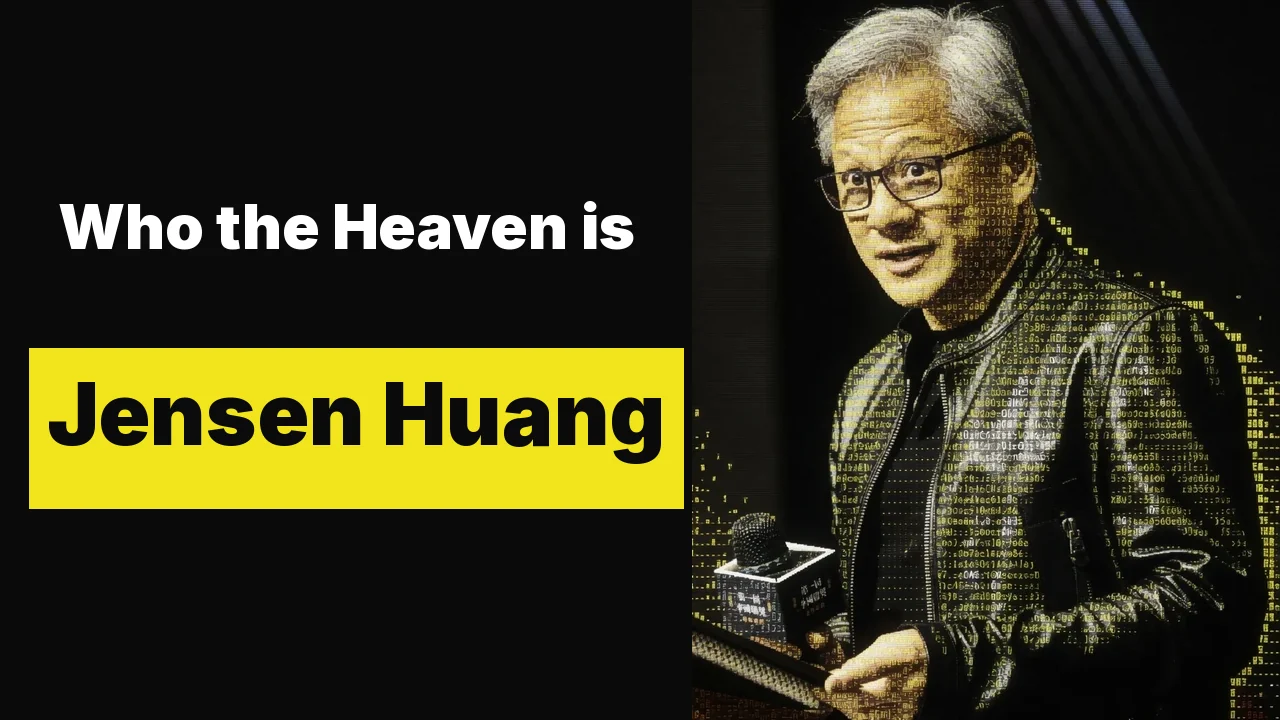
 Artificially generated
Who the Heaven is Jensen Huang: You’re not talking to someone who woke up a loser
This man’s heaven is a stack that needs power at the bottom and spits applications at the top. NVIDIA is the company he built around that stack.
Jensen Huang, born 17 February 1963, co-founder and continuous CEO of NVIDIA since 1993, delivers the sentence of the year at minute 80 of a conversation with Dwarkesh Patel: “You’re not talking to someone who woke up a loser. And that loser attitude, that loser premise – makes no sense to me.” The line sits at 1 hour 20 minutes 23 seconds in an interview that is, at once, one of the best and one of the worst podcasts of this year. Host and guest never find a shared room. That is why it sticks. The logic points go to Jensen. The five-layer explanation of the AI market, the one he lays down there, we have not heard that cleanly before or since. The clash is pain in the brain: Dwarkesh thinks “AI = nuclear weapons” the whole time, Jensen thinks “a poor, unhinged hippie with no plan is riffing on AI = nuclear weapons” the whole time. Then it tips, and the CEO of NVIDIA puts that sentence on the table.
A Denny’s booth, cheap coffee, and nobody telling him the stack is impossible.
Jensen Huang is the man who founded NVIDIA in a Denny’s in East San Jose because it was quieter than home. As a teenager he had washed dishes there, bussed tables, carried coffee. “No one can carry more coffee cups than I can.” This person’s heaven is not the leather jacket on the GTC stage. Heaven is the moment a stack holds: power becomes chips, chips become data centers, data centers become models, models become applications, and nobody in that stack is allowed to wake up a loser.
“You’re not talking to someone who woke up a loser.” The line sounds like testosterone. It sits on a childhood in which a nine-year-old in Oneida, Kentucky, scrubs toilets because an uncle thought the boarding school was prestigious. Knives in the dorm. Smoking at nine, for a week. He later told graduates of that school it was a lucky break. He refuses to book the scene as a defeat.
His paradise is a computer that solves problems a normal computer cannot solve. Games were the first killer app. CUDA was the bet that the same chip could do physics, finance, and later image recognition. The AI boom is not, for him, a 2022 surprise. It is the late receipt for a platform he built against the market in 2006.
He calls it tortured into greatness. The torture was Kentucky first, then the NV1, then thirty years of platform without applause.
Jen-Hsun Huang, later Jensen, is born in Taiwan in 1963. Britannica writes Tainan, Wikipedia Taipei: the collision sits in the table. His father works on a refinery in Thailand. The parents send the sons ahead to the US, to an uncle in Tacoma. The uncle sends them to Oneida. Later Oregon, high school at 16, electrical engineering at Oregon State, a Stanford master’s on the side of the job. AMD in 1984, LSI Logic from 1985 to 1993. At 30 he sits with Chris Malachowsky and Curtis Priem at Denny’s and sketches a graphics company. Priem wanted competitors green with envy: invidia, Nvidia, the i dropped in honor of the first chip, NV1.
The drive is not wealth. In 1993 he has Lori, a one-year-old, a mortgage, no money, no customer, a name nobody can spell. He signs anyway. Later he says he would not take the journey again if he had seen the cost first. Acquired asked him that in Santa Clara in 2023. The answer is heaven from the other side: he loves the work so much he cannot recommend it to anyone who does not already have it in the body.
The company history is a sequence of near-deaths, not a straight line up.
Acquired told it in three episodes plus a conversation with Jensen himself, more than seven hours before the interview. Part I is the GPU company, 1993 to 2006. Part II is the machine-learning company, 2006 to 2022. Part III is the AI boom of 2022 to 2023, which Ben Gilbert and David Rosenthal had to add because they had closed the book in 2022 and the word generative did not appear in that episode.
- 1993Denny’s, then an apartment, then Sunnyvale. Sequoia and Sutter Hill come in. The plan: 3D graphics on the PC, not only on a console.
- 1995NV1. Quadratic primitives instead of triangles. Microsoft Direct3D standardizes triangles. The chip is technically brave and commercially wrong. Sega pays anyway. Shohei Irimajiri, in Huang’s telling, gives NVIDIA about $5 million even after Jensen says the money is probably lost. PC Gamer, December 2025, after the Rogan conversation: Irimajiri simply liked the young man.
- 1996More than half the people gone. From about 100 to 40. Wikipedia, after NVIDIA’s own recaps. Huang later says they were thirty days from the end. He still carries that sentence into keynotes where the company is worth trillions.
- 1997RIVA 128. Triangles, 128-bit memory bus, speed instead of cleverness. The first big sale. GeForce 256 in 1999, marketed by NVIDIA as the first GPU. IPO in 1999.
- 2006CUDA. The graphics card as a general computer. Acquired Part II: rational observers saw a company on a road to nowhere while Jensen poured gaming cash into a platform with no obvious market.
- 2012AlexNet. Krizhevsky, Sutskever, Hinton. ImageNet, a jump the field had been measuring in fractions of a percent. Trained on NVIDIA GPUs. After that the bet is no longer private.
- 2019Mellanox. InfiniBand, the network between GPUs. Acquired stresses this because an AI cluster without a fabric is a pile of cards.
- 2022ChatGPT. Acquired calls it a Netscape moment, maybe an iPhone moment. Hopper, DGX, NVLink, HBM and CoWoS become a scarce industry. NVIDIA is suddenly the firm central banks and defense ministers talk about.
The long version lives at Acquired, not here. What counts here: Jensen never handed the company to a successor. 33 years as CEO. In Silicon Valley that is almost an insult to the governance textbook. It is also why the loser sentence comes from the same mouth that sent half the people home in 1996.
AI is not a model. AI is a five-layer cake, and if you only eat the cherry you do not understand the oven.
In the Dwarkesh conversation and later in the NVIDIA blog of 10 March 2026 under his name, Jensen Huang lays down the same stack. Energy at the bottom. Chips above that. Infrastructure above that. Models above that. Applications at the top. “Energy → chips → infrastructure → models → applications.” Every application pulls on every layer beneath it, all the way to the power plant.
This is the part of the podcast that remains after the clash fades. Dwarkesh presses on models, on one lab, on whether selling chips to China funds a nuclear weapon. Jensen answers with the cake: why sacrifice an entire layer so another one can win? The most important layer is not the model. The most important layer is the applications that diffuse into society. Without energy, chips and infrastructure they do not exist.
Read top to bottom like a cake on a plate: the cherry is small, the base carries everything. Source of the layers: NVIDIA blog, 10 March 2026, Jensen Huang.
Where the use lands. Cars, robots, copilots, drug discovery. Jensen: the layer that has to count most, because it carries the industrial revolution into ordinary life.
Where the public argument lives. GPT, Claude, Gemini, open models from China. A thin layer if you drop the rest. Dwarkesh often stops here. Jensen wants you to keep walking.
Data centers, cooling, clouds, networks. Mellanox sits here. Buy cards with no fabric and you do not have a cluster.
GPUs, HBM, packaging, co-design. NVIDIA earns here. TSMC fabricates. The export fight aims at this layer and pretends it is the whole cake.
Every token is moving electrons. Jensen in the clip: abundant energy makes up for scarce chips, scarce energy forces more throughput per watt. China has power, America has scarcity. That is the floor political debates often forget.
We draw the cake the way Jensen sells it: applications small on top, energy wide at the bottom. That is a claim about causality, not an independent cost ledger. A later breakdown (BigGo Finance, August 2026) puts the largest cost share in the chip layer. That does not contradict Jensen’s value claim. It contradicts the naive reading that money and meaning are the same thing.
The same voice that explains the cake has taken people apart in public, halved the company, and sold a market as morals.
The hell sits here, in the middle, not at the start.
In 1996 Jensen Huang sends more than half the payroll home. The survivors build RIVA 128. He later tells the anecdote as character school. For the people let go it is a layoff. We do not have their names. We have the number: from about 100 to 40.
David Senra pulls “Public Criticism” out of Tae Kim’s book The Nvidia Way: mistakes are said in front of the group so the company learns from one person’s error, not so an ego is spared. Inside that feels like respect (I trust you with the truth). Outside it feels like humiliation. Both can be true in the same minute. Anonymous portraits describe a culture in which you can stand in front of 40 direct reports and hear that your work is not enough. We did not measure that ourselves. We set it next to Jensen’s own teaching and leave the contradiction standing.
The China line in the Dwarkesh conversation is the other break. Jensen says: China is the second-largest market, 50 percent of AI researchers, already enough compute for the worry Dwarkesh has. An embargo would sacrifice the US chip layer, grow a foreign ecosystem, and would not help the application layer. That is NVIDIA interest in the language of statecraft. Dwarkesh hears nuclear weapons. Jensen hears a hippie. The people of another reading, people who treat AI compute as a strategic lead rather than a slice of cake, do not appear in Jensen’s sentence. They sit on the other side of the table, and the table does not hold.
Then the sentence he carries himself: he would not found NVIDIA again if he had seen the cost first. Acquired, October 2023. A heaven that knows its own bill.
One of the best and worst podcasts of this year, and at 1:20:23 the CEO sentence.
Dwarkesh Patel, 15 April 2026, episode: Jensen Huang, TPU competition, chips to China, Nvidia's supply-chain moat. Transcript on dwarkesh.com, video on YouTube, two and a half hours of argument in slow motion. I like conversations in which host and guest find the same room. Here that did not happen. Precisely because they clash that hard, it is interesting.
In this case I am with Jensen, even though I otherwise rate Dwarkesh highly. The logic points go to Jensen, and he understood something almost nobody else puts this sharply: the cake. Jensen has to understand it, because he has probably thought about it more than anyone. The podcast has useful stretches. The five-layer explanation is the best example. Never heard that cleanly before or after.
The clash is pain in the brain. Dwarkesh thinks AI equals nuclear weapons the whole time. Jensen thinks the whole time: a poor, unhinged hippie with no plan is riffing on AI equals nuclear weapons. That is why it tips at this spot, and he puts the sentence out.
The Dwarkesh transcript writes somebody instead of someone, and the dash is missing. We quote the version you hear at this spot in the video, and we link the clip to the second. Then comes the follow-up that completes the sentence: computing is not a car you switch tomorrow. x86 sticks. ARM sticks. CUDA sticks if NVIDIA does the work. Conceding a market on the premise that you will lose it anyway is something he cannot acknowledge. “I don’t think the United States is a loser. Our industry is not a loser.”
Direct link to the second on YouTube · Transcript and player at Dwarkesh
Zvi Mowshowitz dissected the conversation two days later: Dwarkesh is playing a hard hand against a hostile witness, Jensen is talking his book, the cake is also code for the chip layer. Both can be true. The sentence is still the sentence. You’re not talking to someone who woke up a loser. If you hear only macho, you have not read Oneida. If you hear only Oneida, you have not read the chip market.
Inside: nobody in my stack is allowed to think like a loser. Outside: a CEO who files criticism as a loser attitude.
That is the core of the series. Jensen’s heaven is a system that holds. CUDA, NVLink, the cake, teaching in front of the group, the refusal to vacate China: the same motion. From outside, the same motion looks like omnipotence. A man who does not step aside for 33 years, rebukes in public, frames embargoes as stupidity, and in a podcast puts the interviewer in the hippie corner.
The translation fails on one word: loser. For Jensen, loser is a premise that shuts thinking down before the work starts. For Dwarkesh, caution is not a defeat. It is the only adult stance toward a technology he puts next to weapons. Each hears a character flaw in the other. That is the pain in the brain. That is why the sentence you already read above has to stand here again, because it is the translation: You’re not talking to someone who woke up a loser.
If you use NVIDIA without liking Huang, you are still using his heaven. The chip in your machine, the cluster in the desert, the open-source run on a 4090: that is the stack. The leather jacket is wrapping.
A cake of five layers, and the refusal to sacrifice layer two for layer four.
What you can use tomorrow is not the loser sentence as a motivational charm. What remains is the checklist: when someone talks about AI, ask about energy, chip, infrastructure, model, application. If a layer is missing, it is a sermon. When someone talks about NVIDIA, ask about CUDA before 2012, not the 2023 candle. When someone talks about Jensen, hold Oneida and the NV1 in the same hand as GTC.
He understood something most debates cannot carry: intelligence is industry. Tokens are not magic. Tokens are watts, packaging, network, and an ecosystem you do not switch in an afternoon. You’re not talking to someone who woke up a loser. You are talking to someone who sees the stack in his sleep, and who has paid the price for that, on other people and on himself.
The company history has an audio edition. The working method has a second. We embed what embeds, and we link the rest.
Acquired (Ben Gilbert, David Rosenthal) told NVIDIA in three chapters and then sat with Jensen in Santa Clara. Those episodes have video on the Acquired YouTube channel. Founders (David Senra) read Jensen twice from books, he did not interview him: episode 376 as life and firm, episode 403 as working principles only, from Tae Kim. Senra says himself that 376 is the life and 403 is only How Jensen Works. Our series asks for the heaven. Senra asks for the method. You need both.
Acquired runs a player on its own site. That player does not embed cleanly without stealing their layout. Hence the show’s YouTube channel plus the episode pages. We did not find a stable YouTube ID for Founders 376 and 403, so Apple and the show home. Playlist of all NVIDIA episodes: acquired.fm/series/nvidia.
Cash flow times 22. The ratio still fell.
McGrinsey Ratio: market cap on the fiscal year-end date, divided by operating cash flow of that year. NVIDIA, FY2020 to FY2026. Operating cash flow from 4.8 billion to 103 billion dollars. The multiple peaked at 84 in the crypto winter, then came back to 44 once the stack started printing cash.
Fiscal year ends late January. Peak 84 on 29 January 2023, when cash flow had halved and the stock had not. As of 27 August 2026 the trailing twelve months sit at 41.
| Year-end | Market cap | Operating cash flow | McGrinsey Ratio |
|---|---|---|---|
| 26 Jan 2020 | $155 bn | $4.8 bn | 33 |
| 31 Jan 2021 | $326 bn | $5.8 bn | 56 |
| 30 Jan 2022 | $579 bn | $9.1 bn | 64 |
| 29 Jan 2023 | $472 bn | $5.6 bn | 84 |
| 28 Jan 2024 | $1.54 tn | $28.1 bn | 55 |
| 26 Jan 2025 | $2.90 tn | $64.1 bn | 45 |
| 25 Jan 2026 | $4.53 tn | $103 bn | 44 |
The 2023 peak is the tell. Cash halved. The multiple exploded. Then Hopper, then the five-layer stack, then 103 billion dollars of operating cash in a year, and the ratio is back in the forties. Trailing twelve months to 26 July 2026: cash flow 134 billion, market cap about 5.53 trillion on 27 August 2026, ratio 41.
| Claim | Basket | From where |
|---|---|---|
| Born 17 February 1963 in Taiwan | Fact, with a collision on the city | Britannica: Tainan. Wikipedia: Taipei. The date is not in dispute. |
| Oneida Baptist Institute at nine, toilets | Fact on his own account plus profiles | Fortune 5 December 2025, Joe Rogan #2422, Wired profiles. Clay County as a poor county: US statistics, not remeasured here. |
| NVIDIA founded 5 April 1993 at Denny’s | Fact | Wikipedia/NVIDIA historiography, Computer History Museum oral history, Acquired Part I. |
| $40,000 starting capital | Common retelling | Britannica, Business Insider. No original cap table seen. |
| Headcount in 1996 from ~100 to ~40 | Fact in secondary sources | Wikipedia, resting on NVIDIA recaps. No payroll list. |
| Sega money saved NVIDIA, about $5 million | Jensen’s account | PC Gamer after Rogan, 5 December 2025. The sum and Irimajiri’s motive (he liked the young man) are Huang’s story. |
| Loser quote verbatim as in the title | Fact with a transcript variant | YouTube Hrbq66XqtCo, t=4823. Dwarkesh transcript: somebody, no dash. We follow the heard version this piece opens with. |
| Five layers: energy, chips, infrastructure, models, applications | Fact as Jensen’s model | NVIDIA blog 10 March 2026, Dwarkesh conversation, Davos 2026. Not our model. |
| Dwarkesh thinks AI = nuclear weapons | Reading | Our hearing of the interview, not a self-description by Dwarkesh in those words. |
| Heaven = the stack that holds | Reading | Who the Heaven method, bound to Denny’s, CUDA, the cake, the loser line. Not a self-label Huang used. |
- Dwarkesh Patel: Jensen Huang, 15 April 2026Transcript and audio. TPU, China, supply chain, the cake, the loser line.https://www.dwarkesh.com/p/jensen-huang
- YouTube: Jensen Huang on Dwarkesh, t=4823sThe clip where the conversation tips. 1:20:23.https://www.youtube.com/watch?v=Hrbq66XqtCo&t=4823s
- NVIDIA Blog: AI Is a 5-Layer Cake, 10 March 2026Jensen Huang. Energy, chips, infrastructure, models, applications.https://blogs.nvidia.com/blog/ai-5-layer-cake/
- Acquired: NVIDIA playlistParts I to III plus the Jensen conversation. The audio edition of the firm.https://www.acquired.fm/series/nvidia
- Acquired Part I: The GPU Company28 March 2022. 1993 to 2006.https://www.acquired.fm/episodes/nvidia-the-gpu-company-1993-2006
- Acquired Part II: The Machine Learning Company20 April 2022. CUDA until before ChatGPT.https://www.acquired.fm/episodes/nvidia-the-machine-learning-company-2006-2022
- Acquired Part III: The Dawn of the AI Era6 September 2023.https://www.acquired.fm/episodes/nvidia-the-dawn-of-the-ai-era-2022-2023
- Acquired: NVIDIA CEO Jensen Huang (video)15 October 2023. YouTube y6NfxiemvHg.https://www.youtube.com/watch?v=y6NfxiemvHg
- Founders 376, David Senra12 January 2025. Jensen Huang: Founder of Nvidia.https://www.founderspodcast.com/
- Founders 403: How Jensen Works19 October 2025. Tae Kim, 19 ideas. Apple player.https://podcasts.apple.com/us/podcast/403-how-jensen-works/id1141877104?i=1000732570996
- Britannica Money: Jensen HuangBirth in Tainan, NVIDIA, short biography.https://www.britannica.com/money/Jensen-Huang
- Wikipedia: Jensen Huang and NvidiaDate frame, NV1, CUDA, founding. As of August 2026.https://en.wikipedia.org/wiki/Jensen_Huang
- Computer History Museum: Huang oral historyTaiwan, Thailand, Oneida, Oregon, AMD, LSI, NVIDIA.https://www.computerhistory.org/collections/catalog/102809034
- Fortune: nine-year-old janitor in Kentucky5 December 2025, after Joe Rogan.https://fortune.com/2025/12/05/jensen-huang-nine-year-old-janitor-before-nvidia-joe-rogan-podcast/
- PC Gamer: Sega call, $5 million5 December 2025. Huang’s account of Irimajiri.https://www.pcgamer.com/hardware/graphics-cards/during-nvidias-formative-years-its-ceo-reckons-it-had-a-mission-statement-for-a-company-that-has-no-chance-of-success-but-it-was-fine-because-segas-ceo-thought-jensen-was-a-young-man-he-liked/
- Who the Heaven: the methodChapter order, three required questions, hell in the middle.https://mcgrinsey.com/magazin/who-the-heaven-biography-method/
- NVIDIA 10-K, cash from operationsFiscal years ended 26 Jan 2020 through 25 Jan 2026. $4.761 bn, $5.822 bn, $9.108 bn, $5.641 bn, $28.090 bn, $64.089 bn, $102.718 bn.https://www.sec.gov/cgi-bin/browse-edgar?action=getcompany&CIK=0001045810&type=10-K
- NVIDIA 10-Q, TTM operating cash flowPeriod ended 26 July 2026: $134.360 bn.https://www.sec.gov/cgi-bin/browse-edgar?action=getcompany&CIK=0001045810&type=10-Q
- McGrinsey RatioMarket cap at each fiscal year-end divided by that year's operating cash flow. Method.https://mcgrinsey.com/magazin/mcgrinsey-ratio-kgv-wachstumskapital/
As of 27 August 2026. Written with the McGrinsey writing skill. Jensen Huang did not commission this.