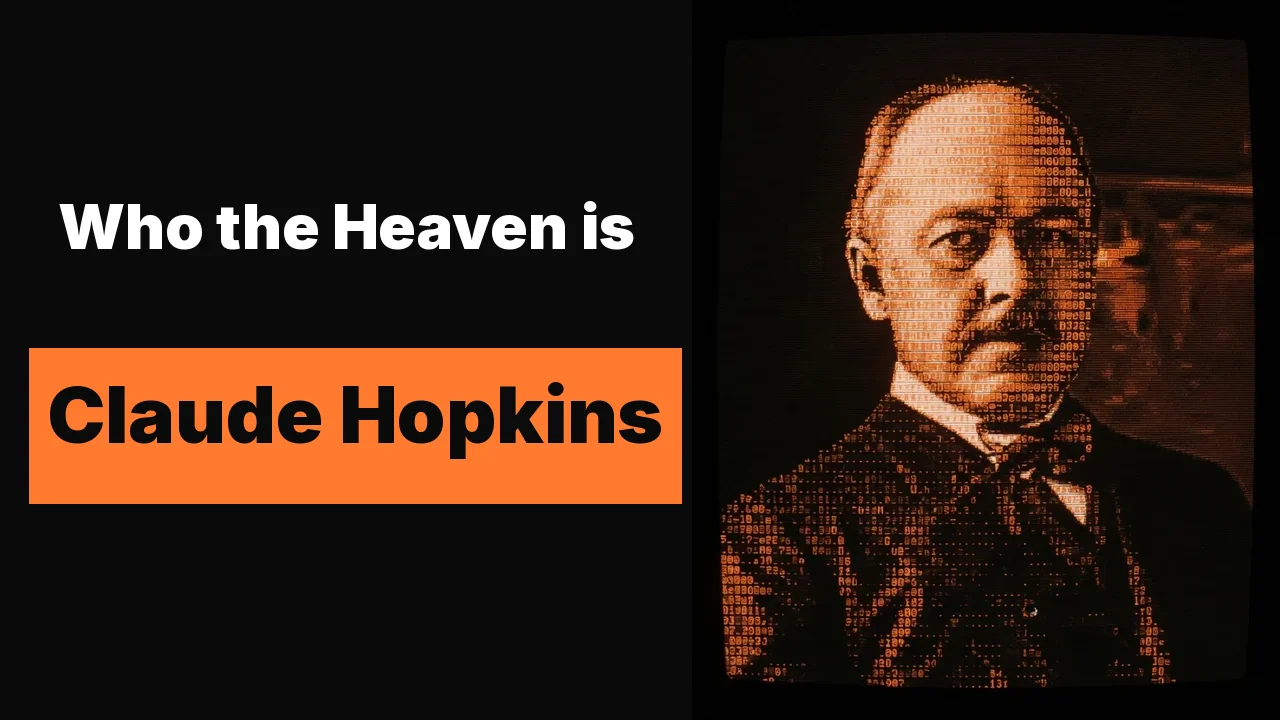
 Artificially generated
Who the Heaven is Claude Hopkins: heaven was a table of coupons
He did not want to be an artist of the advertisement. He wanted to know what an ad costs when someone actually buys.
Claude C. Hopkins (1866 to 1932) is the man who wrote Scientific Advertising and treated advertising like a measuring stick: coupons, test towns, samples, sentences a salesman could also say at the door. His heaven was not fame. His heaven was the moment a number proved the work had not been guessed. Both books sit in this magazine as archive, scan and reading text. This piece is the person.
A typewriter at two in the morning, and nobody in the way.
Hopkins writes in My Life in Advertising that he loves work the way other men love golf. That sounds like a line. Then the scene arrives, and the line collapses: he slips away from weekend guests to get to the machine. Bridge, dinner, dancing are the interruption. The office is the game.
This person's heaven is not a beach. It is the state in which a claim goes into print and comes back later as a number. Coupon. Test town. Sample at the door. If that reads as cold, you have not seen the body: a sickly child, two schoolhouses before class, 65 newspapers after, church janitor on Sundays until ten at night. At nine he earns his own money. The table is the only language in which his childhood felt safe.
"Safety first has been my guiding star." That sits in chapter 1 as a tribute to the Scotch mother. Not as a coaching sentence. As origin.
Not talent. Hours. He says it himself, and he means it as a warning.
"If I have gone higher than others in advertising, or done more, the fact is not due to exceptional ability, but to exceptional hours." That is the sentence David Senra reads in Founders 430, and it is not a humility pose. Hopkins regrets the price in the same paragraph: a man to be pitied rather than envied, because he sacrificed everything else.
The mother, a college graduate and a widow, writes kindergarten books at night and sells them school to school in the holidays. The father leaves poverty. Hopkins calls that a gift: he learned the people "of whom God made so many". The rich, he writes, he could not impress. Tiffany, Rolls-Royce, Steinway: not his customers. 95 percent of buyers were ordinary households. So short sentences. So samples. So the refusal to build a market from his own taste.
He did not invent brands. He gave them a reason nobody had dared to print, because it looked too ordinary.
The Schlitz story is the cleanest. Hopkins walks the brewery. Filtered air, bottles washed four times, artesian wells. The brewers say: everyone does that. Hopkins says: then tell it first anyway. In a few months Schlitz, on his account, sits neck and neck with the leader. The principle later gets called a pre-emptive claim: a truth the whole trade owns, given to the first man who puts it in type.
Pepsodent: not "cleans teeth", but the visible film on them. Beauty, not prevention. Coupons, samples, a higher price. Hopkins takes a stock option. He later calls it the greatest success of his career. Palmolive, Puffed Wheat "shot from guns", Van Camp pork and beans, Goodyear: the same mechanic. Go there. Watch the process. Find the sentence a salesman would not drop at the door.
Twelve woods instead of one. 250,000 in three weeks, the often repeated figure. Source: Hopkins' own telling plus later summaries.
Not the Milwaukee slogan. The walk through. What everyone did, told first.
Toothbrushing as a mass habit. Fluoride came later. That does not turn the campaign into magic after the fact.
Scientific Advertising after he retired as president and chairman. My Life as a debt paid to successors.
The books are the work that remains, because campaigns fade. That is why they sit here as scan and reading text, not as a graveyard of quotes.
- 1866Born, Hillsdale, Michigan
- 1907Lasker hires him at Lord & Thomas
- 1910Schlitz, the brewery walk
- 1915Pepsodent, film on the teeth
- 1923Scientific Advertising
- 1927My Life in Advertising
- 1932Dies at Pineycrest, Spring Lake
Yellow years are the spine. Pepsodent sits late, the books later still.
He sold medicine he later says he no longer approves of.
Chapter 7 of My Life in Advertising is Medical Advertising. Hopkins writes that thirty years earlier medicine advertising was the hardest school, because the goods were worthless without demand. Dr. Shoop. Liquozone. Five years, offices here and in Europe, a doctor in Paris who calls him a nervous wreck. That is not a saint's footnote. That is the core of the friction: the same man who celebrates samples as honesty spent years selling remedies science does not carry.
He later steps away from it. That counts. It does not erase the years. Anyone who reads Hopkins only as the father of performance marketing skips the fact that the hardest school was patent medicine, and that this school taught him the coupon clock.
Second friction, named by him: My Great Mistake. Bissell tells him to go out on his own. Hopkins stays, marries, takes the salary. Decades later he calls that the error of his life: most of the profit stayed with other men.
Third friction: the body. Sixteen-hour days, Sundays as the best working days, two in the morning. He explicitly advises against putting a boy of his through the same. Heaven and hell sit in the same machine.
His heaven arrived outside as coldness. Inside it was the fear of burning someone else's money.
The trade wanted ideas. Hopkins wanted files. Seen from outside, that is a man without poetry. Laid next to the childhood, it is a boy who learned that unproven hope is Vinegar Bitters: the mother makes him take the nastiest medicine in town because waste is a sin. Later he turns that logic around: no claim without a test. The hardness is thrift, translated.
Ogilvy turns it into the cult line about seven readings. Senra turns it into a Founders episode on work ethic. The Wikipedia page stays thin: a man almost nobody outside copywriting knows. All three translations are partly true. None of them tells the heaven first: the joy when Town A sends more coupons than Town B, and nobody has to guess.
Two public-domain books, and a question you can put to any ad tomorrow.
"Would this help a salesman sell the goods?" That is Hopkins' test in one sentence. You can put it on a landing page, a reel, a mail, without knowing the biography. The biography only explains why the sentence was not a technique for him. It was household peace.
What you can take without copying him: samples before you scale. Two towns before you buy the nation. No ad that hides behind mood. And the insight that exceptional hours can be a heaven that burns other people. He wrote that down himself. Read him literally there.
We let other people talk about him, and we say what they are looking for.
David Senra in Founders 430 reads both books and pulls the operating system: hours, tests, headlines. That is the Founders question, and it is legitimate. Our question sits next to it: what did Hopkins need those hours for? For the state in which guessing stops.
Ogilvy: nobody should work in advertising until they have read Scientific Advertising seven times. That quote is the trade's entry ticket. It says nothing about the person, only about the use.
Wikipedia stays a short file: birth, Lord & Thomas, Schlitz, Pepsodent, two books, death in Spring Lake, Hall of Fame 1957. Useful as a frame, too thin as a portrait. That is why the books are open, and why the friction sits in chapter 04, not in the infobox.
| Claim | Basket | Where from |
|---|---|---|
| Born 24 April 1866 in Hillsdale, Michigan | Fact, with a clash | Wikipedia, Oxford Reference. Tri-Cities Historical Museum says 1867. We follow 1866 and mark the conflict. |
| Died 21 September 1932, Spring Lake | Fact | Local death note, Pineycrest, apoplexy. Wikipedia: September 1932. |
| $185,000 a year at Lord & Thomas | Second-hand | David Ogilvy on Lasker. Museum: salary exceeded $185,000 before 1920. Not seen on an independent payroll. |
| Schlitz from fifth to the top via the brewery walk | Hopkins' account | My Life in Advertising. We do not have an independent 1907 market-share series. |
| "The beer that made Milwaukee famous" is Hopkins | Not evidenced here | Oxford attributes it to him. The slogan is older. We leave it out. |
| Pepsodent made Americans brush their teeth | Attribution | Wikipedia "credited with". Causation not measured. The campaign is real, the size of the habit is a thesis. |
| Scientific Advertising sat in a safe for 20 years | Folklore | Late retellings. The book carries a 1923 copyright. The safe line contradicts the date. |
| Heaven = coupon proof | Reading | Our method, tied to scenes in My Life, not a self-label Hopkins used |
- Claude C. Hopkins: Scientific Advertising, 1923LOC scan and our reading text in this magazine.https://mcgrinsey.com/magazin/claude-hopkins-scientific-advertising/
- Claude C. Hopkins: My Life in Advertising, 1927Harper & Brothers. LOC LCCN 27024090.https://mcgrinsey.com/magazin/claude-hopkins-my-life-in-advertising/
- Library of Congress, Scientific advertisingDigitised copy, rights: public domain, free to use and reuse.https://www.loc.gov/item/23009362/
- Library of Congress, My life in advertisingDigitised copy, LCCN 27024090.https://www.loc.gov/item/27024090/
- Wikipedia: Claude C. HopkinsShort biography, as of August 2026.https://en.wikipedia.org/wiki/Claude_C._Hopkins
- Founders Podcast 430, David SenraHow to Write Ads That Sell. Both books as the reading.https://www.founderspodcast.com/episodes/430-how-to-write-ads-that-sell
- YouTube: How to Make Ads That SellThe Senra episode, embedded here.https://www.youtube.com/watch?v=9YrcSWczGdg
- Oxford Reference: Claude C HopkinsShort file on Lord & Thomas, Pepsodent, Scientific Advertising.https://www.oxfordreference.com/display/10.1093/oi/authority.20110803095944564
- Who the Heaven: the methodChapter order, three required questions, hell in the middle.https://mcgrinsey.com/magazin/who-the-heaven-biografie-methode/
Cut-off: 26 August 2026. Written with the McGrinsey writing skill. Audiobook and YouTube of the books come as the next build.