 Artificially generated
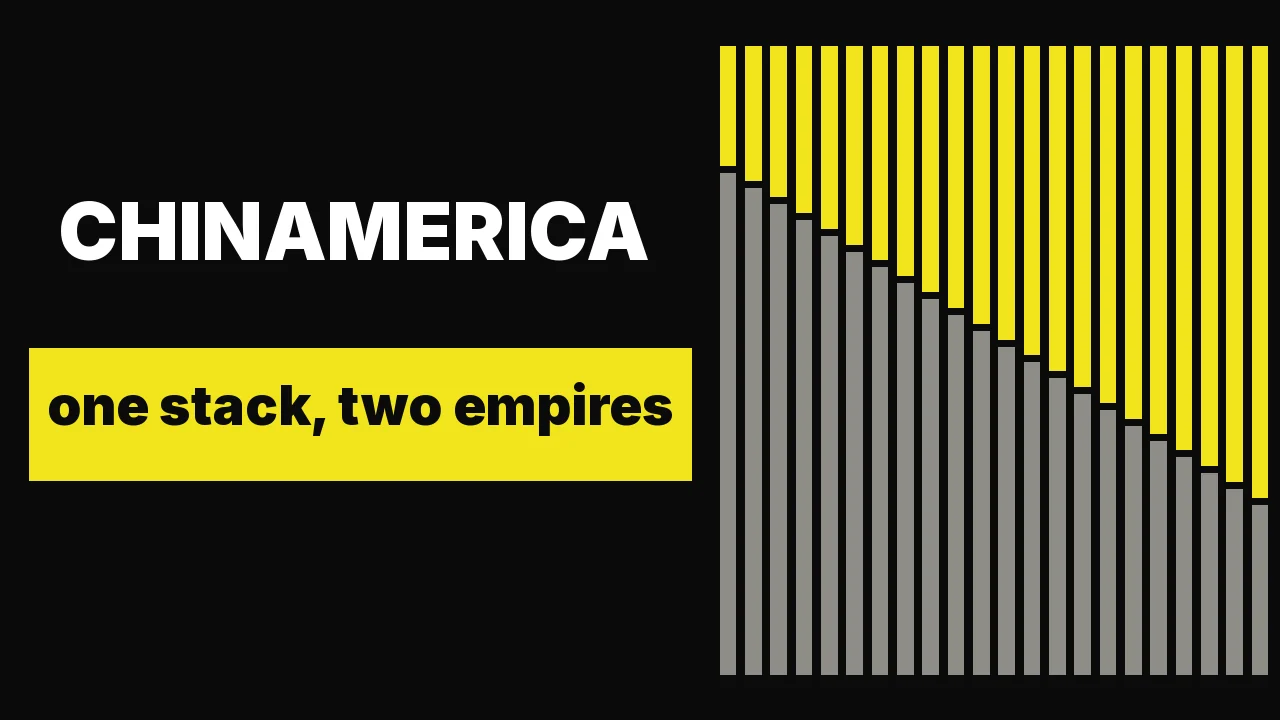
Chinamerica: the two biggest economies already live the same day
Energy is China’s layer. Chips are America’s. Peace is the trickle-down, if they stop treating the other as a system that has to break.
Chinamerica is the name for a world in which the United States and China treat peace and prosperity for their own people as the same long-term goal. On 24 September 2026 Xi Jinping sits in Washington, sixteen days from this page. China’s August surplus just printed $119 billion, the fourth month in a row above $100 billion, on track to beat last year’s $1.2 trillion record. Jensen Huang already drew the map they are sitting on: a five-layer cake, energy at the bottom, applications at the top. They each own a different layer of the same stack. The fight is over who gets to keep the missing pieces. The opportunity is to share them.
If the two biggest economies align on long-term goals, more peace is the likely trickle-down. Not automatic peace. More of it.
The United States and China are the two largest economies on Earth. Almost every other conflict sits in their weather system: oil through Hormuz, chips through Taiwan, rare earths, soybeans, drones, the South China Sea, the price you pay for heating oil in Germany. Raise the alignment between Washington and Beijing and the rest of the board gets quieter. Lower it and everyone else pays the premium.
Alignment here does not mean a merger, a flag, or a world government. It means goal alignment: the realisation that both populations want the same long-run goods, peace and prosperity, and that those goods are not a contradiction. China is not 1966. It is authoritarian capitalism with a communist label. A Shenzhen office worker and a Dallas office worker live nearly identical days. The political systems sit on top of that shared day like two different operating systems on the same hardware.
The hole in the claim is real, and it belongs in the first section, not as a footnote. The Chinese Communist Party’s top goal is not prosperity. It is regime survival. Prosperity is the tool. When those two conflict, survival wins. That is why the crackdowns on tech billionaires and private tutoring happened. A Shenzhen office worker can want the same Tuesday as a Dallas one and still live under a leadership that will burn the Tuesday to keep the Thursday.
Xi said the quiet part at the banquet in Beijing on 14 May 2026, in a toast the Xinhua readout put on the record: the great rejuvenation of the Chinese nation and making America great again can go hand in hand. That is Chinamerica in one sentence, spoken by the man who would have to mean it.
Remove the part where you cannot say what you want in public, and most of the remaining day looks the same.
Alarm. Smartphone. Commute. A job that is some mix of screens, meetings, and a boss. Dinner. Scroll. Sleep. That is Shenzhen. That is Dallas. That is Hamburg. For most people in China there is no daily theatre of ideology. There is rent, a child, a battery percentage, a subway map. The communism in the name does not show up in the morning the way the party wants foreigners to believe, and it does not vanish the way boosters want to believe either.
The speech gap is the part that is not small. It is the mechanism that keeps a regime in contact with its own numbers. People still say what they want among friends. They cannot organise around it, cannot correct course in public, cannot force the centre to hear a number it does not like. The everyday-life argument is the strongest piece of Chinamerica. The speech argument is the hole inside it. Both can be true at once.
Work, phones, cities, consumption, exams, property anxiety. A 2026 urban Chinese life is closer to a 2026 American life than either is to 1976 in its own country.
A Dallas voter can fire a party. A Shenzhen diner cannot fire a Politburo. The same people who grumble at dinner cannot turn the grumble into a course correction the centre has to take.
If the days already rhyme, the remaining fight is over who writes the firmware: energy, chips, sea lanes, rules. That is a smaller, harder, more useful argument than civilisation-clash theatre.
Jensen Huang put energy at the bottom and applications at the top. China owns the basement. The US owns the silicon. The war, if it comes, is a fight over the missing layers of one cake.
NVIDIA CEO Jensen Huang has been repeating the same model since at least his CSIS conversation in December 2025 and the NVIDIA blog of 10 March 2026: AI is a five-layer cake. Energy, chips, infrastructure, models, applications. Intelligence generated in real time requires power generated in real time. Every token is electrons converted to math. The binding constraint is not the model. It is the watt.
His handicap, said out loud, is the Chinamerica map. China has roughly twice the energy of the United States as a nation, and it is growing straight up while the US is flatter. On chips, he said, America is generations ahead. Abundance of energy makes up for worse chips. Abundance of chips makes up for scarce energy. A 7-nanometre chip with cheap power can do Hopper-class work if you do not care about performance per watt. That is China’s bet. Extreme co-design on limited watts is America’s.
Width is hierarchy, not GDP. The yellow floor is the binding constraint. Handicap per layer is Jensen’s, not a measurement of ours.
Agents, cars, factories, phones. Contested. China ships into mass markets at a velocity US firms keep underestimating.
The layer most pundits think is the whole cake. It is the fourth slice. Open weights and closed labs, both sides.
Jensen’s comparison: a US data centre takes years, China builds a hospital in a weekend. Velocity is a layer.
Design, EUV, TSMC, NVIDIA, CUDA. The layer Washington tries to lock. The layer Beijing tries to clone.
The floor. Tokens are watts. Whoever can generate and deliver power at scale feeds every layer above.
Source for the model: NVIDIA blog, 10 March 2026, and the CSIS conversation, 3 December 2025. “Twice the energy” and “generations ahead on chips” are Jensen’s words, not a McGrinsey audit of generation capacity.
This is either a reason to cooperate or a reason to fight over the missing pieces. China can build the basement faster than anyone. It cannot independently build the silicon above it at the leading edge, which is why SMIC, Huawei Ascend, and every workaround still orbit one fact: no EUV. The United States can design the chip. It is slower at pouring the concrete and connecting the megawatts. TSMC is buying America a copy of layer two at a price the CFO put at four to five times a Taiwan fab. Space-based solar, microreactors, fusion: those are American bets on layer one. They are late. They are also the kind of race that makes the species richer even if the flags stay stubborn.
Energy competition is good for humanity because it forces the buildout. Chip competition is good for humanity until someone decides the only way to keep layer two is to bomb the island that still holds most of it. Chinamerica is the bet that sharing the cake beats splitting it with a missile.
Xi is sixteen days from Washington. China just printed another $119 billion surplus. The G20 could not even write a sentence about it.
The diplomatic calendar is denser than it has been in years. Trump and Xi met in Beijing on 14 and 15 May and agreed, on the Chinese readout, to a “constructive, strategically stable relationship.” The White House did not repeat the phrase. They will meet again in Washington on 24 September, at APEC in Shenzhen on 18-19 November, and at the G20 in Miami on 14-15 December. US Trade Representative Jamieson Greer told Fox News on 3 September he is optimistic. “The Chinese very much want to have a stable relationship. That’s the word they use: stability. We’re in favour of that as well.”
Stability is the floor. The ceiling is sitting in the same week’s numbers. Treasury Secretary Scott Bessent told Reuters the world cannot have a China with a $1.2 trillion trade surplus. At the G20 finance meeting in Asheville, 19 of 20 members agreed to language on “excessive and persistent external surpluses.” China was the dissenter. There was no communiqué. Beijing said it never deliberately pursues a surplus and accused Bessent of manufacturing pretexts. Then Chinese customs printed August: $119.09 billion more sold than bought, year-to-date already over $800 billion, on track to beat the record.
Xi has been on the road to show he has alternatives: Egypt on 1 September, the Shanghai Cooperation Organisation in Kyrgyzstan with Russia and Iran, a four-country swing the Washington Post filed as a pitch that China is the stable one. That is the other movie, running on the next screen. Chinamerica has to beat that movie, not narrate past it.
On AI, Reuters reported a dedicated US-China safety dialogue for mid-September, Bessent leading the American side, the first official bilateral talks devoted only to AI since Trump returned. A White House official told the same reporters there is currently no planned AI-related meeting in mid-September. Both sentences are on the record. The subject is not. Washington wants labs to police themselves on AI-directed cyberattacks. Chip export controls stay in a different room, on purpose.
- 30 Oct 2025Busan. First Trump-Xi meeting of the second term.
- 14-15 May 2026Beijing state visit. Banquet invitation for 24 September. “MAGA and rejuvenation can go hand in hand.”
- 16 Jul 2026TSMC: another $100 billion for Arizona, total $265 billion.
- 28 Aug 2026Trump announces the Venezuela oil deal: 65 billion barrels, NABEP, Pentagon 35%.
- 31 Aug 2026Adm. Samuel Paparo meets Gen. Yang Zhibin, PLA Eastern Theater, in Victoria. First in-person, two-year gap closed.
- 1 Sep 2026G20 finance: China blocks the communiqué. Bessent names the dissenter in public.
- 8 Sep 2026China August trade: +25% exports, $119 billion surplus. This page.
- 24 Sep 2026Xi in Washington. The test of whether stability is a floor or a ceiling.
If you take Taiwan off the table for one section, the remaining pile is still large enough to start a war. It is also large enough to make a deal.
Chips and AI. The United States wants to keep China off the leading edge. China wants the opposite, and is building its own fabs, models, and workarounds. Both sides treat this layer as the future of military superiority. A safety dialogue that leaves export controls in the other room is a start. It is not a settlement.
The South China Sea. China claims almost the whole of it. The US and the Philippines run patrols against that claim. Water cannons on fishing boats are the small picture. The large picture is who writes the rules for the sea lanes that carry the energy in layer one and the goods in China’s surplus.
Trade. Tariffs sit on both sides. China throttles rare earths and has played games with US soybeans. The US blocks drones and solar silicon. Bessent wants the rest of the G20 to examine their terms of trade with China because US tariffs pushed the surplus into Europe and Latin America instead of deleting it. Greer is talking about a Board of Trade for non-sensitive goods and farm sales as the September deliverable. That is a valve, not a peace treaty.
Who writes the rules. China wants a system without Western primacy. The US wants its alliances to hold. Xi’s Egypt and Central Asia swing is the demonstration that Beijing can assemble a room that does not include Washington. Trump’s Venezuela deal is the demonstration that Washington can assemble energy in its own hemisphere so it needs the Gulf, and therefore China’s Iran file, less. Both are empire logic. Both are also, if you squint, the raw material of a bargain: you keep your near abroad, I keep mine, we stop treating the whole planet as a zero-sum board.
The loud version of Chinamerica says: give the island, unlock the century. The history is more crooked than a gift shop, and 23 million people live in the shop.
Lead with energy and chips and Taiwan becomes a conclusion some people want to jump to. The jump has a shape. Taiwan is geographically China’s island, 150 kilometres off Fujian, on the Eurasian Plate, a collision zone with the Philippine Sea Plate, which is why it is mountainous and why it shakes. Japan took it by force in 1895, Treaty of Shimonoseki, after the First Sino-Japanese War, and held it for fifty years. In 1945 the Allies handed it to the Republic of China, Chiang Kai-shek’s Nationalists, who were then the internationally recognised government of China. The Communists were still fighting on the mainland. They had no claim on the island in 1945. They won the mainland in 1949. Chiang fled with about a million people. Both sides claimed to be the one true China. The UN seated the Nationalists until 1971, then seated Beijing.
In the year 1000, Taiwan was not a Chinese province. The Song ruled the mainland and had no real presence on the island. Indigenous Austronesian peoples lived there. Han settlement in numbers follows the Dutch trading post of 1624. The Qing annex in 1683 and treat it as a backwater until they lose it. The sentence that survives contact with the record: Taiwan was a Qing prefecture for 212 years, a Japanese colony for 50, a Nationalist refuge for 77 and counting, and never governed by the People’s Republic. Beijing’s claim is political and historical. It is not a deed from the year 1000.
The Texas analogy is the strongest version of the gift argument. If Texas seceded, built the world’s chip foundry, and China recognised Texas, armed it, and bought the chips, Washington would not call that self-determination. It would call it a raid. Germany knows the separated-country file: East, West, then one state again. Korea still lives the unsolved version. From a civilisation-high-score view, handing Taipei to Beijing looks cheap against a US-China war that would kill far more than 23 million. That view is coherent. It is also a view that does not ask the 23 million.
The Nationalists were the Kuomintang, Sun Yat-sen’s party, which overthrew the Qing in 1912. Chiang took over after Sun died and ran the mainland from 1928 until 1949. They were not nice. In 1927 Chiang purged the Communists in Shanghai, thousands killed in days, then campaigns that killed hundreds of thousands more. On Taiwan they crushed a local uprising on 28 February 1947, then ran the White Terror: martial law until 1987, tens of thousands arrested or executed. Chiang had German military advisors, his adopted son trained with the Wehrmacht, and in 1935 he said fascism is what China now most needs. The Blue Shirts were modelled on Mussolini’s Blackshirts. Historians still stop short of calling the regime fascist. Authoritarian nationalism with a fascist flavour, not a totalitarian mass movement. Anti-communist, ruthless, and in the 1930s cozy with actual fascists. Chinese nationalists who wanted a strong, unified, modern country.
The Communists were not the gentle twin. Early idealism was real. So were purges in the base areas, then the campaigns that followed victory. The Nationalists were brutal nationalists. The Communists were brutal universalists. Different flavours of cruelty, not one noble origin and one backwards one. Who the Heaven starts with the heaven, parks hell in the middle, and does not end there. Chiang’s heaven was the modern unified state. Mao’s was the same state minus the landlords and the foreign concessions. The people on Taiwan now live in a democracy of 23 million that mostly wants the status quo, not unification and not a declaration of independence that would force the issue. You can advocate peaceful unification in Taiwan. Political parties do. Calling for a Chinese invasion gets you fined, deported, or prosecuted. The chill is social: the independence camp owns media and campus, so the unification voice is legal and fringe. On the mainland the mirror is an arrest.
The gift theory has a second hole. Teaching Beijing that pressure works is not humility. It is an invitation to the next demand. Taiwan is also not a US asset. It is more Chinese than American in language, food, family, history. “More Chinese than American” does not mean “should be ruled from Zhongnanhai,” any more than Ireland should have stayed British because it is more British than Chinese. The chip leverage is real: TSMC still makes the overwhelming share of the most advanced logic, and Taiwan knows what that buys. The US is paying to copy the factory. C.C. Wei said the first Arizona fab’s N4 yield matches the mother fab. The CFO said building in the US costs four to five times Taiwan. Bernstein’s Mark Li put US self-sufficiency for advanced chips at 40 to 50 percent between 2030 and 2032. Know-how transfers. Japan did it. Korea did it. It takes decades, not a press release. The tacit knowledge is the part you cannot paste into a prompt.
The US is already moving, quietly, in the direction the gift people want, without using the word gift. After May, arms and statements became negotiating chips. Xi keeps asking for a formal US line against Taiwan independence. Whether Beijing treats a concession as the start of Chinamerica or as the next bite is the actual question, and it is not answered by geology.
Chinese intelligence is not stupid. The filter sits above the analysts, not inside their IQ.
This is a pin, not a chapter. The temptation is to zoom into Zhongnanhai palace intrigue. Resist it. The structural point is enough, and it is older than this Politburo.
A smart service still reports to a boss who decides what counts as bad news. That is the dictator’s dilemma: the more power you concentrate, the less anyone dares tell you the truth, so the picture gets filtered before it reaches the top. High-resolution satellites show you the other country. They do not show you what your own system is hiding from you. The Soviet Politburo had brilliant analysts. They still misread their own economy for decades.
Xi’s public diet is People’s Daily, Xinhua, CCTV, internal briefings, Politburo study sessions. The Goethe-and-Shakespeare reader is image. The live question for Chinamerica is not “how cultured is he.” It is whether a deal that requires him to hear a loss can survive the last metre of the briefing chain. We do not have a clean inventory of what is kept from him. Anyone who claims to have that inventory is selling. The pin stays in until we do.
The fastest alignment path is not a manifesto. It is the calendar, plus a first deal small enough that cheating costs more than keeping it.
They are already talking. Diplomats constantly, services constantly, and now the theatre commanders again: Paparo and Yang, 31 August, Victoria, British Columbia, first face to face, after two years of the Eastern Theater and Indo-Pacific Command not sitting in the same room. Hegseth has been selling a reboot of the military channel since last autumn. Former Pentagon people call the upgrade marketing. The meeting still happened. An empty hotline is worse than a thin one.
Good faith is the only way to start. It is not a strategy. It is a bet. The bet works when both sides have something to lose by cheating. A symbolic handover of Taiwan is the biggest prize on the table, which makes it a terrible first step. A Board of Trade on non-sensitive goods, farm purchases you can count, an AI incident channel with a phone that rings, a watt-and-wafer working group that publishes a joint number once a quarter: those are first steps. Defection is visible. Compliance is boring. Boring is how empires de-escalate.
The moral line “you cannot cooperate with authoritarians” is theatre. The US cooperated with Stalin to beat Hitler, with Mao to contain the Soviets, with Saudi Arabia for oil. Cooperation was never about regime type. It was about interests lining up. The real objection is verification: authoritarian regimes break deals when it suits them, and you cannot audit them the way you audit a parliament. That is a design problem for the first step, not a reason to skip the first step.
On 24 September the cameras will want Taiwan. The useful conversation is the cake: who builds the watts, who builds the wafers, who gets to sell the application, and what a joint number on each layer would have to look like for both sides to sign it. Taiwan comes later because it is the prize. Prizes are how you end a sequence. They are how you blow one up if you put them first.
Chinamerica is not a private hallucination. It has a literature. Most of it refuses to lead with the island.
Graham Allison spent a career on the Thucydides Trap: the pattern where a rising power and a ruling power go to war. His later move is the useful one for this page: rivalry partnership. Compete hard, cooperate on the existential layer. That is Chinamerica without the poetry.
Jennifer Kavanagh, now at Defense Priorities, has been the clearest Western voice that US interests in Taiwan do not justify fighting China over it. In the March 2026 Brookings-RAND set she argues for taking US force off the table, building Taiwan’s own defence, and using a pullback as leverage for a bargain in which Beijing talks and eases military pressure. That is the gift logic with the 23 million still holding a porcupine instead of a ribbon.
Wu Xinbo at Fudan published “The Case for a Grand Bargain Between America and China” in Foreign Affairs on 31 December 2025. Subtitle: how Trump and Xi can reset relations. His terms: Washington reconforms to One China and stops containment-as-identity, Beijing delivers economic goods and an easier line on Taiwan. Goal, in his words, if not outright partnership: peaceful coexistence and productive power sharing. Jeffrey Sachs has been saying in public that containment failed and diplomacy is the remaining sane path. The Quincy Institute publishes the nearest institutional home, common-good diplomacy, restrain-and-deal rather than primacy-and-preach.
The spread tactic that actually works is the one this piece is built on. Do not lead with Taiwan. Lead with the cake. People already feel energy bills and chip shortages. Taiwan is the conclusion some of them will reach. It is a worse headline, because it trips the moral reflex before the stack can be seen.
| Claim | Basket | From where |
|---|---|---|
| Xi state visit to Washington on 24 September 2026 | Fact | Trump invitation at the 14 May Beijing banquet, NYT live file, White House and Xinhua readouts, Wikipedia page on the May visit. |
| Xi: rejuvenation and MAGA can go hand in hand | Fact as toasted | NYT 14 May 2026, banquet remarks. Chinese-side formulation. |
| Further 2026 meetings: APEC Shenzhen 18-19 Nov, G20 Miami 14-15 Dec | Fact in the specialist literature | David Shambaugh, China-US Focus, 21 May 2026, citing the post-summit calendar. Treat as scheduled, not as completed. |
| China August surplus $119.09 billion, exports +25% | Fact | Chinese customs via NYT 8 September 2026 and AP same day. Fourth month above $100 billion. YTD over $800 billion. |
| 2025 China goods surplus about $1.2 trillion, a record | Fact | Bessent to Reuters 30 August 2026; repeated in G20 coverage. Last year’s print, not this year’s. |
| China blocked the G20 finance communiqué | Fact as named by Bessent | Bessent press conference, Asheville, 1-2 September 2026, Bloomberg and AP. China was the 1 of 20. Beijing denies the surplus is a strategy. |
| Greer is optimistic about stability | Fact as spoken | Fox News interview, 3 September 2026, quoted by SCMP 4 September. Word used: stability. |
| Mid-September US-China AI safety talks, Bessent to lead | Reported, officially denied | Reuters 4-5 September, two sources. White House official: “currently no planned AI-related meeting in mid-September.” Agenda not final. |
| Paparo met Yang Zhibin on 31 August 2026 | Fact | US Indo-Pacific Command statement, China Defense Ministry confirmation, SCMP 4 September, Japan Times 5 September. First in-person, two-year command-level gap. |
| TSMC extra $100 billion on 16 July 2026, total $265 billion US | Fact | TSMC Q2 2026 earnings call, FT, Arizona Republic. First fab N4 yields matching Taiwan: company and CFO comments on the same call. US build cost 4-5x Taiwan: CFO. |
| US self-sufficiency 40-50% of advanced chips by early 2030s | Estimate | Mark Li, Bernstein, to Nikkei Asia, June 2026, on the extra $100 billion. Not a TSMC guarantee. |
| Venezuela deal: 65 billion barrels, NABEP, Pentagon 35% | Fact as White House terms | White House fact sheet 31 August 2026. Trump announcement 28 August. Chevron $7 billion / ~600,000 bpd: 2 September coverage. Production at scale is years out. Caracas stresses sovereignty and a 25-year frame against the 100-year concession language. |
| Brent about $97 on 8 September 2026 | Fact, rounded | ICE front-month, MarketWatch last $97.31, Investing.com prints in the mid-to-high $90s, session high near $99.45. Not $99 as a close. |
| Five-layer cake: energy, chips, infrastructure, models, applications | Fact as Jensen’s model | NVIDIA blog 10 March 2026, CSIS 3 December 2025, Dwarkesh 15 April 2026. “Twice the energy” and “generations ahead on chips” are his handicap, not our audit. |
| Taiwan was never a PRC-governed province | Fact | Standard history: Qing 1683-1895, Japan 1895-1945, ROC from 1945, PRC never administered the island. Song-era presence is not a province. |
| Populations already live the same Tuesday, so goals are aligned | Thesis, with a stated hole | This piece. Hole: CCP goal hierarchy is survival first, prosperity as tool. Speech is the correction loop, not a lifestyle detail. |
| Handing Taiwan to Beijing is a cheap price for peace | Argument, not a fact | Civilisation-score view in the source conversation. Counter: 23 million, status-quo preference, incentive teaching, chip prize relocates rather than vanishes. |
- NYT: China’s surging exports loom over Trump’s talks with Xi8 September 2026. August surplus $119.09 billion, exports +25%, G20 clash.https://www.nytimes.com/2026/09/08/business/china-exports-xi-trump-talks.html
- NYT live: After Xi’s warning on Taiwan, a positive tone14 May 2026. Banquet, 24 September invitation, MAGA and rejuvenation line.https://www.nytimes.com/live/2026/05/14/world/trump-xi-summit-beijing
- Forbes live updates, Beijing summit14 May 2026. Invitation to the White House on 24 September.https://www.forbes.com/sites/siladityaray/2026/05/14/beijing-summit-trump-invites-xi-to-the-white-house-in-september-live-updates/
- David Shambaugh: Parsing the results of the Xi-Trump summit21 May 2026. Board of Trade, Board of Investment, three more 2026 meetings.https://www.chinausfocus.com/foreign-policy/parsing-the-results-of-the-xi-trump-summit
- SCMP: Greer optimistic the US and China can stabilise ties4 September 2026. Fox News interview, Board of Trade as September deliverable.https://www.scmp.com/news/china/diplomacy/article/3366318/trade-chief-greer-optimistic-us-and-china-can-stabilise-ties
- Reuters: Bessent on China’s $1.2 trillion surplus, G2030 August 2026. “The world cannot have a China with a $1.2 trillion trade surplus.”https://www.reuters.com/world/china/g20-countries-should-consider-more-trade-barriers-with-china-cut-imbalances-2026-08-30/
- Bloomberg: China prevented the G20 communiqué1-2 September 2026. Bessent names the PRC as the dissenter.https://www.bloomberg.com/news/articles/2026-09-01/bessent-says-china-prevented-g20-communique-over-imbalance-spat
- Washington Post: Xi’s September travel6 September 2026. Egypt, SCO, the pitch of China as the stable pole.https://www.washingtonpost.com/world/2026/09/06/rare-flurry-trips-xi-pitches-china-stable-alternative-us-under-trump/
- Reuters / CNBC: mid-September AI safety talks4-5 September 2026. Bessent to lead. White House official denies a planned meeting.https://www.cnbc.com/2026/09/05/us-china-gear-up-for-mid-september-ai-safety-talks-reuters.html
- SCMP: Paparo and Yang Zhibin in Victoria4 September 2026. Command-level contact after a two-year break, meeting 31 August.https://www.scmp.com/news/china/military/article/3366413/china-us-military-commanders-snap-2-year-break-talks-canada
- NVIDIA blog: AI is a 5-layer cake10 March 2026. Jensen Huang. Energy as binding constraint.https://blogs.nvidia.com/blog/ai-5-layer-cake/
- CSIS: Jensen Huang on securing American leadership on AI3 December 2025. Twice the energy, generations ahead on chips, four to eight times the cost.https://www.csis.org/analysis/nvidias-jensen-huang-securing-american-leadership-ai
- Dwarkesh Patel: Jensen Huang15 April 2026. Cake, energy making up for chips, the loser line.https://www.dwarkesh.com/p/jensen-huang
- FT: TSMC another $100 billion in the US16 July 2026. Total commitment $265 billion.https://www.ft.com/content/491927e1-1532-486d-94ec-8d6ee2de7bcd
- Wccftech: TSMC CFO on US fab cost20 July 2026. Four to five times Taiwan. N4 yields matching the mother fab.https://wccftech.com/tsmcs-cfo-admits-us-fabs-cost-four-to-five-times-more-than-taiwan-yet-doubles-down-with-100b-bet/
- White House fact sheet: Venezuela oil agreement31 August 2026. NABEP, 65 billion barrels, 35% OSC, veto, offtake rights.https://www.whitehouse.gov/fact-sheets/2026/08/fact-sheet-president-donald-j-trump-announces-historic-oil-agreement-to-secure-american-energy-dominance-and-drive-venezuelas-economic-recovery/
- S&P Global: NABEP $100 billion, 1 million b/d target1 September 2026. Chevron as a separate track.https://www.spglobal.com/energy/en/news-research/latest-news/crude-oil/090126-nabep-plans-100-billion-venezuela-investment-targets-1-million-bd-oil-output
- MarketWatch: Brent front month8 September 2026. About $97, session high near $99.46.https://www.marketwatch.com/investing/future/brn.1
- Wu Xinbo: The Case for a Grand Bargain Between America and ChinaForeign Affairs, 31 December 2025. How Trump and Xi can reset relations.https://www.foreignaffairs.com/united-states/case-grand-bargain-between-america-and-china
- Brookings-RAND: US Taiwan policy papers, March 2026Jennifer Kavanagh’s dissent: interests do not justify fighting China over Taiwan.https://www.brookings.edu/wp-content/uploads/2026/03/FP-20260319-brookings-rand.pdf
- Who the Heaven: the methodHeaven first, hell in the middle, never first and never last. Used on Chiang and Mao in section 06.https://mcgrinsey.com/magazin/who-the-heaven-biography-method/
- Who the Heaven is Jensen HuangThe cake in biographical form, 27 August 2026.https://mcgrinsey.com/magazin/who-the-heaven-is-jensen-huang/
Research cut-off: 8 September 2026, evening CEST. Written with the McGrinsey writing skill. Chinamerica is a thesis, not a government programme. Neither Washington nor Beijing commissioned this.