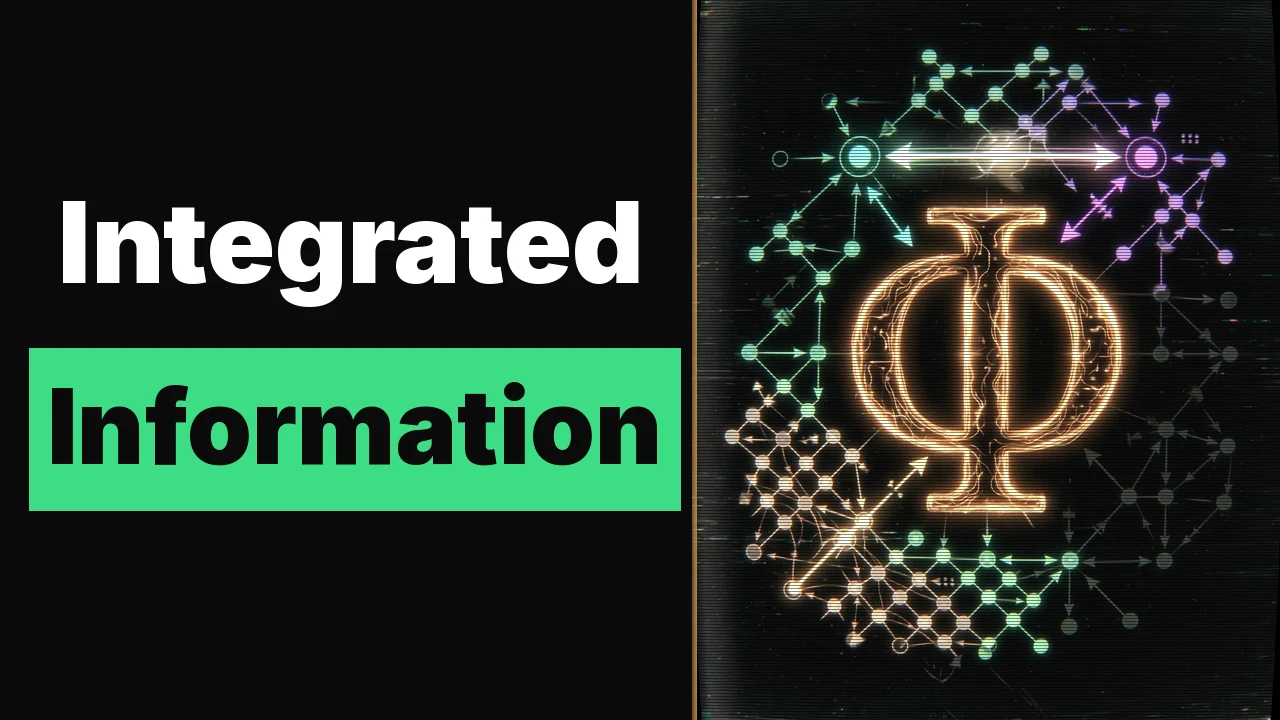
 Artificially generated
Integrated Information Theory: Phi, the 124, and the worldview
IIT is not information technology. IIT is Giulio Tononi’s Integrated Information Theory. Phi does not measure how much you know. Phi measures how hard the parts of a system causally constrain each other.
Integrated Information Theory (IIT) has, since 2004, been the attempt to write consciousness as a number: Phi, Φ. Tononi, University of Wisconsin–Madison. As of 28 August 2026 the theory sits at version 4.0 (Albantakis et al., PLOS Computational Biology, October 2023). 124 researchers called it pseudoscience on PsyArXiv on 15 September 2023. A survey of authors of consciousness-theory papers (n=60) found 8 percent fully agreeing with that letter and 20 percent not at all. The Cogitate Nature paper of 30 April 2025 is hard on both theories: parts of IIT and GNWT land, core claims of both get hit. Wikipedia carries the fight, and the criticism section is the real article.
The theory does not start from the brain. It starts from experience and asks what physics would be forced to look like.
David Chalmers set the Hard Problem so that physical explanations never quite catch the feeling itself. IIT reverses the direction: experience exists (zeroth axiom), so any conscious substrate must have certain properties. From phenomenology to postulates about cause-effect power. Wikipedia, as of August 2026, calls it a theory that wants to say which system is conscious, to what degree, and what experience it has.
Wikipedia: Integrated information theory · German article. The criticism section of the English page is required reading, not the lead. Searle, Aaronson, the 124, Graziano, Bayne, and the Templeton adversarial collaboration live there. The Nature paper of 30 April 2025 (Cogitate Consortium) says the results align with some predictions of IIT and GNWT and substantially challenge key tenets of both. For IIT, a lack of sustained synchronisation in posterior cortex contradicts the claim that network connectivity specifies consciousness.
IIT applies to any system. Human, fly, photodiode, computer, organoid. Not bound to biology. That is why some people treat it as the first fundamental theory, and others as a panpsychism engine.
Phi is not a pile of knowledge. A dictionary holds a lot of information and near-zero Phi if nobody causally binds anybody.
The common misread: a system that knows more things is more conscious. IIT says the opposite of that naive version. It is not the amount of stored bits. It is how strongly the parts of a system constrain each other’s possible next states, such that the whole cannot be split into independent parts without losing that power. Irreducible cause-effect power, from the inside.
Small phi (φ) measures the irreducibility of a mechanism. Big Phi (Φ) measures that of the whole cause-effect structure of a complex, the set of units with maximal φs. A cerebellum with about 69 billion neurons can be huge and still contribute little, because the wiring is modular and largely feed-forward. A smaller, densely recurrent net in posterior cortex can, on IIT, be the seat. That is the standard account of why size alone does not buy experience.
The calculation is often impossible for real brains. PyPhi, Mayner et al. 2018, does it for toy systems. Proxies (PCI after TMS-EEG, Casali et al. 2013) get used clinically to guess whether integrated complexity is still there in unresponsive patients. PCI is not Phi. PCI is the clinical cousin you can pay for.
Five properties of experience, five demands on physics. Reject the axioms and you reject IIT.
Tim Bayne: these axioms are not axioms. They are claims about phenomenology you can deny. That is the philosophical on-ramp for opponents. The mathematical on-ramp is Aaronson, section 08.
Two cells, four states. The trick is not the count. The trick is the wire between them.
Take cell A and cell B. Each can be on or off. Together, four combinations: both off, only A, only B, both on. Two unconnected cells have the same four combinations. The difference is independence. Without a wire, A’s state says nothing about B’s next state. With a bidirectional wire, A constrains B’s possibility space, and B constrains A’s. Information, in IIT, means: restriction of possibilities by causal power. Phi rises when that restriction cannot be split into two separate stories.
A has on/off. B has on/off. Four combinations, zero constraint. Phi near zero, two mini-complexes instead of one.
The same four states, but B’s next step depends on A and vice versa. The whole does something the parts cannot do apart.
Everyday version: two people in separate rooms, each thinking. Four combinations of “talks / silent,” and still no conversation. The same four once an intercom runs both ways, and suddenly there is a shared history. IIT claims consciousness is that shared history at the level of mechanisms, not the volume of the separate voices.
Leung et al. 2021 computed Phi on fly neural populations. Under anaesthesia ΦMax dropped, matching the prediction. Small system, real calculation, not a metaphor. That is the empirical level IIT currently occupies: flies, TMS-EEG, predictions about posterior versus prefrontal activity. Not: the Phi of your laptop.
There is no consciousness boss. There is a lab in Wisconsin, an evangelist in Seattle, and a letter with 124 names.
Opposite, section 07: Hakwan Lau, Joseph LeDoux, Chris Frith, Adrian Owen, Bernard Baars (the Global Workspace man), Patricia Churchland, Daniel Dennett, Keith Frankish, Scott Aaronson, John Searle, Michael Graziano, Tim Bayne. That is not a fringe. That is a large part of publicly visible consciousness research, plus computer science, plus philosophy of mind.
IIT splits intelligence from consciousness. A computer can do everything you do and, on the theory, feel nothing.
Computational functionalism says: the right computation is enough. IIT says: the right causal structure in the substrate is enough, the computation alone is not. Findlay, Marshall, Albantakis, Koch, Tononi, 2024 preprint: a digital computer that perfectly simulates a small target system does not reproduce its Phi-structure. CPU, registers, clock, split of memory and processing multiplex virtual neurons through the same physical units. Result: many mini-complexes, negligible Phi. Koch in Neuron 2024: digital computers can do everything we can do, and never be what we are.
Neuromorphic hardware and quantum computers are left open. Organoids could, on the reverse point, have experience and little intelligent behaviour. Pseudo-consciousness is IIT’s name for systems that act as if.
That is the political core the 124 letter fears: coma, abortion, AI regulation, organoids. If IIT counts as “the” theory, ethical borders move along Phi, which nobody can compute for a brain.
15 September 2023, PsyArXiv, Fleming et al.: IIT as pseudoscience until it is testable. The fight has been the state of the field since.
The letter has 124 signatures. Names that carry the field: Hakwan Lau (organiser), Joseph LeDoux, Chris Frith, Adrian Owen, Bernard Baars, Patricia Churchland, Daniel Dennett, Keith Frankish. Charge one: IIT is not a leading theory, it gets too much press. Charge two: implications for clinic and ethics without empirics. Charge three, the one that exploded: pseudoscience, because the theory as a whole is not testable. The Cogitate results of June 2023 had not hit the core.
A count, as clean as it gets. For IIT: the IIT 4.0 author list (about 15), plus Koch, plus clinical PCI groups, plus Hoel, plus parts of Cogitate. There is no counter-letter with 124 names. Against: 124 signatories in 2023; in March 2025 a Nature Neuroscience commentary “What Makes a Theory of Consciousness Unscientific?” from many of the same writers; New Scientist speaks of about 100. The anonymous Comcensus survey of paper authors 2013–2023, query “consciousness AND theor*”, 60 replies: 8 percent fully with the letter, 20 percent not at all, the rest in between. Most respondents do not stick the label on, and do not sign IIT either.
Templeton put more than $6 million into the adversarial test of IIT against GNWT. The 2023 first readout, per Wikipedia, put 2 of 3 IIT predictions over the preregistered threshold, GNWT none. The peer-reviewed Nature paper of 30 April 2025 is harder on both: parts land, cores wobble. For IIT, sustained posterior synchronisation fails. The editorial scolded the pseudoscience language. Koch on the letter, April 2025, New Scientist: jealousy, IIT was “sexier,” getting attention and money. Lau on Koch’s New York Times line, The Atlantic 2023: that sentence (“the only really promising fundamental theory of consciousness”) had driven him for years.
Short lines, full addresses. Proponents first, then opponents, then people who hate the label and still will not buy IIT.
“the only really promising fundamental theory of consciousness”
Christof Koch, New York Times, as quoted by Hakwan Lau. The Atlantic, 29 September 2023.theatlantic.com … /675503
Digital computers can do everything we can do, but will never be what we are.
Christof Koch, Neuron 2024, IIT’s line on machines. Wikipedia paraphrases the same point via Findlay 2024.IIT is a theory, of course, and therefore may be empirically wrong.
Christof Koch, Scientific American, 21 September 2023, against the word pseudoscience.scientificamerican.com … bogus-science
“I think it’s inflammatory to describe IIT as pseudoscience.”
Anil Seth, Scientific American, 21 September 2023.same piece
unboundedly more conscious than humans are
Scott Aaronson on inactive logic gates wired the right way. Shtetl-Optimized, 21 May 2014.scottaaronson.blog/?p=1799
the expander graphs are not conscious
Aaronson, same post. Integration without a mind, LDPC codes, DVD players.scottaaronson.blog/?p=1799
they can only aspire to wrongness
Aaronson on almost all rival consciousness theories. IIT is wrong, and therefore in the top 2 percent, because it is wrong enough to be capable of being wrong.scottaaronson.blog/?p=1799
“a magicalist theory” with “no chance of scientific success”
Michael Graziano, Attention Schema Theory, cited in the Wikipedia criticism.Wikipedia, Criticism
The problem with panpsychism is not that it is false; it does not get up to the level of being false.
John Searle against IIT, Wikipedia criticism, panpsychism without a clear notion.Wikipedia, Criticism
We have a duty to protect the public from scientific misinformation.
Fleming et al., open letter, PsyArXiv 15 September 2023.osf.io/preprints/psyarxiv/zsr78
If Blaise is alone with himself, does he lose consciousness?
Joscha Bach, 21 August 2026, against Blaise Agüera y Arcas’s Economist essay that consciousness is relational between entities. The essay is Blaise’s, not Bach’s.x.com/Plinz/status/2090892235030036683
The camps are not a random sample. They pull along metaphysics, job, and fear of the next ethics call.
Anil Seth sits between: empirically interested in integration, against identity and panpsychism, against the word pseudoscience. Gomez-Marin and Seth, Nature Neuroscience March 2025: a science of consciousness beyond pseudo-science and pseudo-consciousness. That is the third party, and it is smaller than both loudspeakers.
Same theory, two courts. The table is the shortest way to hold both without reconciling them.
| Point | IIT says | Opponents say |
|---|---|---|
| What consciousness is | Identical to the Phi-structure of a complex | Category error. Phi measures network efficiency, not experience (Merker, Rudrauf, Williford) |
| Testability | Predictions about cortex vs cerebellum, anaesthesia, PCI, parts of Cogitate | The core (identity, Phi as experience) is metaphysical, 2025 commentary. Nature 2025 also hits IIT cores |
| Panpsychism | Photodiodes have tiny Phi, that is a feature | Searle: not even false. Letter: ethically dangerous |
| Logic gates / expanders | Tononi accepts high Phi, compares it to cortical cytoarchitecture | Aaronson: then a DVD code is more conscious than you |
| Digital AI | Function without substrate Phi = pseudo-consciousness | Functionalism: same function, same mind. IIT discriminates against silicon without cause |
| Computation | PyPhi for mini-nets, proxies for clinic | Super-exponential, proxies have no proven link to Phi (Mediano, Seth, Barrett 2018) |
| Media | A real fundamental theory earns attention | 124: too much press, too little test. Koch: jealousy |
| Axioms | Read off experience itself | Bayne: not axioms. Graziano: magic |
IIT paints a universe in which experience is a form of causal power. Not a spark, not a soul, not a computation.
What exists, as IIT stacks it. Not an independent measurement. A map of the theory.
Beside that, in the same physics, almost without Phi: cerebellum, feed-forward nets, classical computers, a bag of photodiodes with no recurrence. Aaronson’s point: also expanders and codes with huge Phi and no mind anyone will recognise.
Examples IIT itself uses. Thermostat: tiny Phi, a wisp of experience. Photodiode: same. Human awake: high Phi. Human under anaesthesia, dream sleep versus dreamless, vegetative versus minimally conscious: PCI distinguishes, Phi is supposed to ground it. Split-brain: two complexes possible. A room full of people: no mega-experience above the heads, because exclusion keeps the maximum local. The universe as a whole: depending on connectivity, either thin Phi or, in speculative readings, a panpsychist sheet. Koch in Nautilus 2024: only consciousness exists for itself; in deep sleep you do not exist for yourself, only for others.
That is a worldview, not a measurement. It is coherent if you swallow the axioms. It is a disaster for common sense if Aaronson is right that common sense is the only available test, and IIT fails it on DVD players.
Bach builds consciousness as software that simulates itself. Blaise makes it relational. IIT makes it a form. Three theories, one unsolved field.
Joscha Bach, master’s in computer science at HU Berlin, PhD in cognitive science at Osnabrück summa cum laude, book Principles of Synthetic Intelligence at Oxford University Press, stints at the MIT Media Lab and Harvard, now executive director of the California Institute for Machine Consciousness in the Bay Area. Core: consciousness is not a stuff, it is an information process, a virtual self-model. Cyberanimism: spirits as self-organising software, AI as a form of life. That is functionalism with a self-model, not IIT. CIMC pursues a machine-consciousness hypothesis with a functional nervous system, not with Phi.
An Economist essay of 20 August 2026, “Humanity has the debate about AI consciousness backwards,” is by Blaise Agüera y Arcas, Google, not by Bach. Blaise: consciousness is not an objective property a system has, it is relational between entities. “We don’t care for others because they’re conscious. We believe they’re conscious because we care about them.” Bach, 21 August, on X: if Blaise is alone with himself, does he lose consciousness? The mix-up of the two texts circulated. It is wrong. Fact, in the table below.
Our reading, closer to Bach than to Tononi and closer to a self that holds than to ego-death: a conscious system needs drive (wanting to stay), memory that lasts, sensors, resources. The constantly updating self-model is the I. Without the knowledge that you are here, there is no one for whom Phi could feel like anything. IIT can describe the self-model as part of the Phi-structure. It does not have to make it a condition. That is where the paths split. More on the I: Ego is hot!.
| Claim | Bin | From |
|---|---|---|
| IIT 2004 by Tononi, current 4.0 | Fact | BMC Neuroscience 2004; Albantakis et al. PLOS Comp Biol 2023 e1011465. |
| 124 signatories, letter 15 Sep 2023 | Fact | Fleming et al., PsyArXiv, DOI 10.31234/osf.io/zsr78. Nature report 20 Sep 2023. |
| Comcensus 8% fully agree, 20% not at all, n=60 | Fact as survey | comcensus.org, cited on Wikipedia. Small, self-selected sample. |
| Nature 30 Apr 2025 Cogitate: both theories partly supported, cores challenged | Fact as paper abstract | Cogitate Consortium, Nature 642, 133–142. DOI 10.1038/s41586-025-08888-1. Wikipedia reported the 2023 first readout as IIT 2/3, GNWT 0. |
| Koch: “only really promising fundamental theory” | Fact as quote in a secondary source | The Atlantic 29 Sep 2023, Lau on Koch in the New York Times. Original NYT sentence not re-verified here. |
| Aaronson: expanders / gates can have higher Phi than humans | Fact as argument; Phi number not measured | Shtetl-Optimized, 21 May 2014. Tononi accepts the implication, per Wikipedia. |
| Digital computers have ~no consciousness on IIT | Fact as IIT implication | Findlay et al. 2024 preprint; Koch Neuron 2024. Holds only insofar as IIT holds. |
| Economist essay Aug 2026 relational consciousness | Fact, attribution corrected | Blaise Agüera y Arcas, 20 Aug 2026, not Joscha Bach. Bach replied on X on 21 Aug. |
| Consciousness = updating self-model | Reading | Bach / this piece. Not IIT, not consensus. |
| No consensus definition of consciousness | Fact as state of the field | Wikipedia IIT, Hard Problem, rival theories (GNWT, predictive processing, AST, illusionism). |
- Wikipedia: Integrated information theoryOverview, axioms, criticism section. As of August 2026.https://en.wikipedia.org/wiki/Integrated_information_theory
- Wikipedia: Integrierte InformationstheorieGerman page.https://de.wikipedia.org/wiki/Integrierte_Informationstheorie
- Tononi 2004: An information integration theory of consciousnessBMC Neuroscience. The origin paper.https://pmc.ncbi.nlm.nih.gov/articles/PMC543470/
- Albantakis et al. 2023: IIT 4.0PLOS Computational Biology e1011465.https://journals.plos.org/ploscompbiol/article?id=10.1371/journal.pcbi.1011465
- Fleming et al. 2023: IIT as PseudosciencePsyArXiv, 124 signatories, 15 Sep 2023.https://osf.io/preprints/psyarxiv/zsr78
- Nature: Consciousness theory slammed as pseudoscienceMariana Lenharo, 20 Sep 2023.https://www.nature.com/articles/d41586-023-02971-1
- The Atlantic: The Science of Consciousness Is Having a Rumble29 Sep 2023. Lau, Koch NYT quote, 124.https://www.theatlantic.com/technology/archive/2023/09/integrated-information-theory-consciousness-scientific-explanation/675503/
- Aaronson 2014: Why I Am Not An Integrated Information TheoristShtetl-Optimized. Expander, Vandermonde, Pretty-Hard Problem.https://scottaaronson.blog/?p=1799
- Cogitate / Nature 30 Apr 2025Adversarial collaboration IIT vs GNWT.https://www.nature.com/articles/s41586-025-08888-1
- New Scientist, 30 Apr 2025Bitter argument, Koch on jealousy, ~100 in the 2025 commentary.https://www.newscientist.com/article/2478564-bitter-argument-breaks-out-over-controversial-theory-of-consciousness/
- Comcensus survey on the open letter8% fully, 20% not at all, n=60.https://comcensus.org/public/publicMain.php?q=open_letter_IIT
- Casali et al. 2013: PCIScience Translational Medicine. TMS-EEG, clinic.https://www.science.org/doi/10.1126/scitranslmed.3006294
- Blaise Agüera y Arcas, Economist, 20 Aug 2026Relational consciousness. Not Bach.https://www.economist.com/by-invitation/2026/08/20/humanity-has-the-debate-about-ai-consciousness-backwards
As of 28 August 2026. Written with the McGrinsey writing skill. Wikipedia criticism read, not just the lead.