 Artificially generated
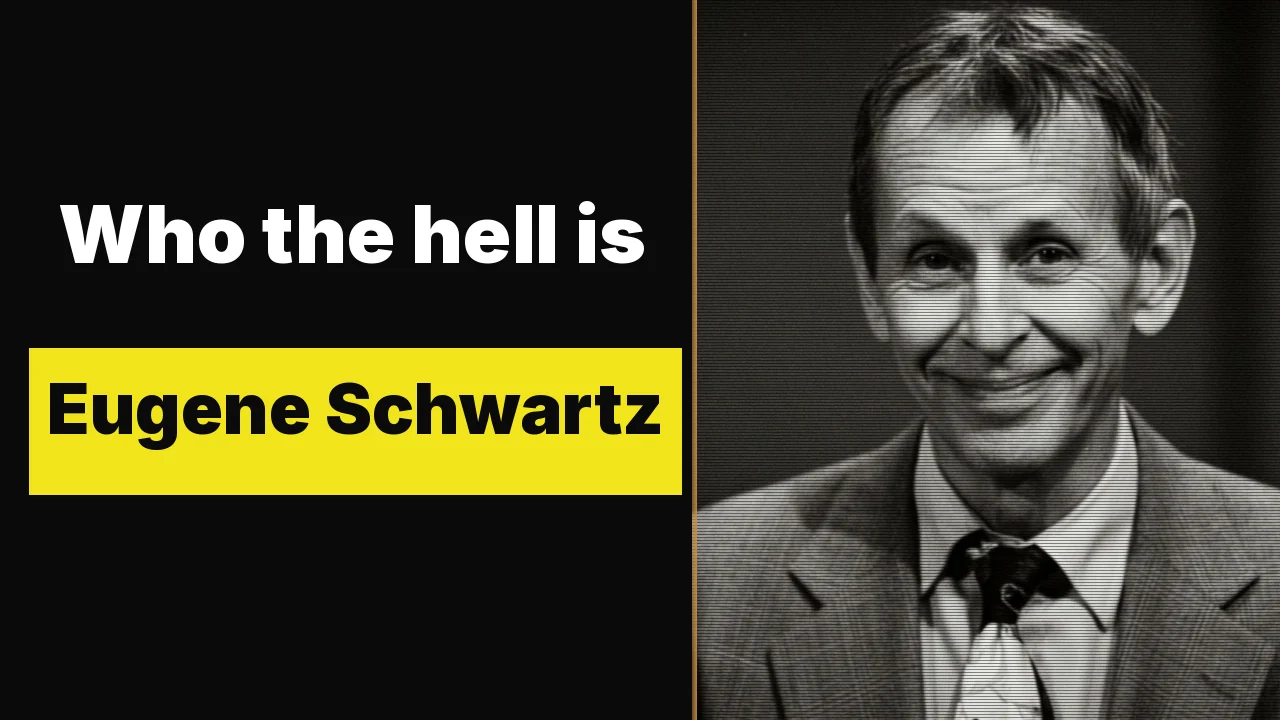
Who the Hell is Eugene Schwartz?
A man nobody knows is considered by the people who want your money to be the most dangerous copywriter of all time. Time to do the math instead of repeating the myth.
His book was out of print for 51 years. Used copies sold for more than a thousand dollars, more than some first editions of real literature. His own obituary in the New York Times mentions his advertising copy in a subordinate clause and his art collection in three paragraphs. And the framework that every 97-dollar course now sells under his name, the five stages of market awareness, doesn't appear in that exact form anywhere in his book. We wanted to know how much of the legend holds up. Short version: more than we thought, and completely different from what the marketing course tells you.
Google "Eugene Schwartz Wikipedia" and land on a dead link
en.wikipedia.org/wiki/Eugene_Schwartz sends you to a Soviet playwright who died in 1958 and never wrote an ad. en.wikipedia.org/wiki/Eugene_M._Schwartz delivers the digital equivalent of a shrug: 404. For a man who is treated like a demigod in the direct marketing world, whose book Breakthrough Advertising became a cult object, there is simply no page. No paragraph, no infobox photo, no category "American copywriters". Nothing.
This is not a footnote. This is the first data point of this report: Eugene Schwartz is huge within a subculture and completely invisible outside of it. What exists instead: an obituary in the New York Times from 1995. And that's the real punchline.
From Errand Boy to the Man Who Wrote Boardroom Reports
Schwartz came to New York in 1949 to write the great American novel. It was never finished. What was finished instead was one of the most lucrative careers direct advertising has ever seen. The following timeline is compiled from multiple mutually confirming sources, see bibliography.
An Unusual Business Idea
Through his own company "Instant Improvement" he sold health and self-help titles, with titles like "How To Rub Your Stomach Away". And then the actual trick: he took no fee. He traded his copy for his clients' buyer lists, because access to millions of proven willing buyers was worth more than any check.
Research from the Newsstand
For market research he read the National Enquirer weekly. Not out of irony, but because that's where the "mass desire" lived, as he called it: the existing longing of the masses, raw and unedited. He was married to Barbara Schwartz, interior designer and art consultant. Together they built one of the most significant private collections of contemporary American art of their time, which explains his obituary and is the actual punchline of this entire report.
A book that fetched collector prices beyond a thousand dollars
Breakthrough Advertising was published in 1966 by Prentice-Hall and initially sold modestly. In 1984 there was a reprint through Boardroom Books. After that the book disappeared from the market for decades, and that's exactly what made it one of the most expensive used professional books ever.
The rights are now held by Brian Kurtz, who worked alongside Schwartz at Boardroom for over two decades. Together with Barbara Schwartz, Gene's widow, he secured the rights and republished the book in 2017 through his company Titans Marketing. Not a fan project. A man who put his own money on the line betting that the legend is real.
Anyone who wants to know how seriously the scene takes the book only needs to look at the prices. Before the reprint, used copies cost between around 270 and over 1,600 dollars depending on the seller. Today the official reprint costs 125 dollars, with accompanying course 199.
An out-of-print advertising book, traded more expensively than most first editions of classic literature.
All prices in US dollars, as of the respective quoted sales offers. The bar length is the real value, not compressed.
His complete work, as far as verifiable
| Title | Year | Publisher | Status |
|---|---|---|---|
| Breakthrough Advertising | 1966, reprint 2017 | Prentice-Hall, then Titans Marketing | Well documented, currently available |
| The Brilliance Breakthrough | 1975 | Frederick Fell Publishers | Well documented, available antiquarian |
| Confessions of a Poor Collector | 1970 | from a lecture at the New York Cultural Center | Well documented, topic art collecting, not advertising |
| How to Double Your Child's Grades in School | 1965 (stated) | Frederick Fell (stated) | Weakly documented, no independent publisher page found |
| Mail Order: How to Get Your Share... | unclear | unclear | Weakly documented, only findable through secondary sources |
What's really available from him for free, and what only for money
Three categories, cleanly separated: legal and free, legal but only for purchase, and stuff that obviously also circulates as pirated copies. We fundamentally don't link to the third category. Not out of prudishness, but because the rights holder currently lives off exactly this sale.
| Material | Access | What it costs | Note |
|---|---|---|---|
| Around 10 individual original ads | legal & free | 0 | swiped.co and swipewell.app, freely viewable swipe-file collections |
| Breakthrough Advertising, book | paid only | 125 to 199 $ | Directly from the rights holder, no legal free version |
| 204 scanned ads + 3 mailings | paid only | 297 $, bundle | Origin of the scans on the sales page not disclosed, see section 09 |
| Lecture at Phillips Publishing, 1993 | paid only | 597 $ | 90 minutes plus 32-page transcript, license origin of the recording not documented |
| Confessions of a Poor Collector | antiquarian only | varies | No finding of a legal online full-text source |
| Third-party analyses and summaries | legal & free | 0 | Numerous on YouTube and in blogs, but are secondary material, not original Schwartz |
The five stages of market sophistication
This is the core of Breakthrough Advertising, and it's the part that really sticks: a market is not a state, it's an age. The more often a promise has been repeated, the deafer the market becomes to it, and your strategy must age along. That's exactly why the advertising idea that would have hit ten years ago doesn't work today, not because it's bad, but because the market has reached a different stage without asking you.
Schwartz describes five stages, from the birth of a market to its exhaustion. The animation shows how the necessary strategy shifts with each stage, from direct claim to pure identification.
| Stage | State of the market | What works now |
|---|---|---|
| 1 | New, no competition yet | Name the need directly and dramatically |
| 2 | Competition has entered | Enlarge the original promise |
| 3 | Market has heard all direct promises | Introduce a new mechanism that makes the old promise credible again |
| 4 | Competing mechanisms are piling up | Expand and refine your own mechanism instead of escalating the promise further |
| 5 | Market is exhausted, deaf to every claim | Switch from promise to identification, the customer should recognize themselves in the brand |
"Mass desire" is genuine Schwartz. The "5 stages of awareness" are only partly so.
The central quote, well documented
"The power, the force, the overwhelming urge to own that makes advertising work, comes from the market itself, and not from the copy. Copy cannot create desire for a product. It can only take the hopes, dreams, fears and desires that already exist in the hearts of millions of people, and focus those already-existing desires onto a particular product. This is the copywriter's task: not to create this mass desire, but to channel and direct it."
In English, raw and without frills: the power comes from the market, not from your text. You invent nothing. You only direct what is already burning.
80 percent research, 20 percent writing
"I will take the best copywriter in this room, who is sloppy and careless, and match him against a good copy cub. And 2 out of 3 times, the sloppiness of the great person will be beaten by the carefulness of the other person. Because the power of the ad is always in the product itself. It is NOT in the copywriter."
From his lecture at Rodale, and it is uncomfortable for anyone who relies on talent: diligence beats genius, two out of three times.
Seven techniques in body copy
For the actual text work, Schwartz names seven techniques with which a promise is made credible in the text: intensification, identification, gradual approach, redefinition, mechanization, concentration and camouflage.
38 ways to support a claim
Plus a catalog of around 38 methods to substantiate a headline claim, for example through measurement, comparison, paradox, challenge, before-after, case study or authority. The catalog itself is well documented in secondary sources, we could not verify a complete original list outside the book.
A giant in a niche, no name in the advertising industry
We tried to quantify the influence instead of just claiming it. The result clearly tips in two directions simultaneously.
Within the direct marketing and copywriting scene, the influence is real, concrete and backed by money. Gary Halbert described Schwartz as a personal friend and mentor for two decades. Brian Kurtz has done more than praise, he risked his own capital to bring the book out of obscurity. Todd Brown, a well-known modern direct marketing trainer, names him as the single greatest influence on his work.
Outside this scene: yawning emptiness. Not a single hit in the usual awards of the classic advertising industry, no Cannes Lions, no Hall of Fame list. Google Scholar shows for Breakthrough Advertising around 50 academic citations, solid for a practical book, but far from "epochal".
The most honest influence indicator remains the market price itself: a professional book out of print for decades that nevertheless changed hands for hundreds of dollars is real, paying demand. No mention in a listicle buys you that.
Around 50 academic works list Breakthrough Advertising in their bibliography
A claim is a number. Evidence is a clickable list. We retrieved the "Cited by 50" list directly from Google Scholar and selected the works with a reliable, directly accessible link. The complete list is openly available for anyone to view via the link above.
| Work | Year | Classification |
|---|---|---|
| Prasad: "Communications-Effectiveness of Comparative Advertising", Journal of Marketing Research | 1976 | Peer-reviewed, strongest academic evidence |
| Golden: "Consumer Reactions to Explicit Brand Comparisons", Journal of Marketing Research | 1979 | Peer-reviewed, second JMR work |
| Sapir & Tarusan: Adaptation of Schwartz's awareness scale, i-KEIZAC conference | 2021 | Applies the stages directly as a measurement tool |
| Lockton: "Design with Intent", in Living Labs (Springer) | 2016 | Textbook chapter, behavioral design |
| Morys: "Customer centricity as foundation of growth" (Springer) | 2018 | Textbook chapter, marketing practice |
| Akarsu: "Content Marketing", in Leveraging Digital Marketing for Tourism (Springer) | 2025 | Current textbook chapter, tourism |
| Lambert & Welch: Home Study Advertising Handbook, ERIC database | 1993 | Department of Education ERIC database |
| Nelson: The Design of Advertising, indexed at CiNii | 1989 | Standard work on ad design |
Those who collect his ads rarely say where they come from
We wanted to know where the people who compiled Schwartz ads got their material. The honest answer: most collections don't say anywhere. Not an accusation. Just the state of research.
| Collection | Scope | Access | Stated Origin |
|---|---|---|---|
| swiped.co, Eugene Schwartz profile page | ≈ 10 ads, 1967 to 1981 | free | Only named for Boardroom launch letter, otherwise no attribution |
| SwipeWell, curated selection | several examples | free | Explicitly described as compilation "from across the web," a secondary curation |
| Scribd individual documents ("Over Thirty", "Models Stay Young") | 1 ad each | free to view | Appear to be re-uploads from the swiped.co collection, no original source attribution |
| scientificadvertising.com, bundle | 204 ads + 3 complete mailings | $297 | Seller describes "digitally restored" scans that "took years," without saying from which physical sources they came |
A rare recording, a Rodale conference room, a man with three pens
We watched a rare video recording of an internal Rodale presentation by Eugene Schwartz. A longtime Rodale editor introduces him and lists what he brought the company: 30 mailings, 27 of them test winners against their own in-house writers, nearly 8 million books sold, around $200 million in revenue. Schwartz seems almost shyly grateful at the start. Then the tone completely shifts. He announces he will be "completely transparent," the way you can ask a computer to show every calculation step. People, he says, have built-in circuits for opacity. He wants none today.
What follows is not a lecture on advertising psychology. It's a man meticulously demonstrating how he physically works, and that's exactly what makes the recording more valuable than any summary of his book.
He describes a 1,100-page manuscript, two weeks of reading time, every claim bracketed in red pencil, the table of contents deliberately set aside unread because he wants to experience the claims "as a surprise," not pre-filtered through someone else's structure. At the end, a typist extracts from it a 50 to 60-page document he calls "Vocabulary." Only then does what most people think of as copywriting begin. He himself doesn't call it that. His most important sentence of the entire talk: Copy is not written, it is assembled, from claims, images and desires, "a little city of longing in which the reader wants to live."
Then he pulls out a timer live on camera and explains his ritual: 33 minutes and 33 seconds, always the same desk, for 28 years, deliberately chaotic. The only rule: you don't have to write, but you can't do anything else, not even another task. After one or two minutes of boredom, he says, the work pulls you in by itself. And when the timer rings, he stops immediately, in the middle of the best sentence, because he's convinced that the actual connection work doesn't happen in the focused block, but in the break afterward. He therefore always carries a pen with him, even in the shower, and his best ideas emerge in book margins on vacation, not at the desk.
Most impressive are two small, almost casual anecdotes. Once he corrects a doctor on the phone, whose own manuscript he was editing, about a line on eggs in nutrition that the doctor had deleted because he was certain he'd never written anything about eggs. Schwartz quotes him the page number. The doctor laughs, amazed, because a layman knew his own field better than he himself did in that moment. The second story, almost identical, with a theologian and a Bible passage. Both times the same punchline: whoever is most thoroughly prepared wins, not whoever is most talented.
Then comes the part that's worth most for practice. Why every claim eventually dies, no matter how true it is, once the market has heard it often enough, and why the solution is never a louder claim, but a new, unfamiliar mechanism that makes the same old claim credible again. His example, casually thrown out: an ad that promises to dust drawers without removing the contents. Sounds impossible. That's exactly the point.
And he dissects live one of his own ad lines, "Sneaky little arthritis tricks," four completely ordinary words, he says, none of them special by itself, the power lies solely in the combination. "Sneaky" is actually a negative word in advertising, he says, but works here because it promises exactly what someone is looking for who has failed with every doctor: forbidden insider knowledge. For the same book he deliberately adopted the medical vocabulary from the patient letters that made up the book, terms he himself barely knew, because precisely these words trigger immediate recognition in the reader, not because they sound nice.
At the end, almost as an aside, he recommends as required reading the National Enquirer, gossip magazines, trash television, and advises watching the big action movies of the season multiple times in a row and checking with a stopwatch how often a new stimulus comes. Copy should have the same rhythm, he says. Don't meander.
The distillate
Six principles from the recording, condensed for practice.
The OG Schwartz Belt
Ten questions from this report, including the two places where half the marketing world misquotes Schwartz. All correct: black belt. No login, no saving your data, progress stays only in your browser.
What of this is fact, what is thesis, and what is just someone else's claim that we have verified
The text above has a point of view. These three tables do not. Cleanly separated: measured values, our own interpretations, and claims by others that we have cross-checked. Anyone who only wants to know what really stands rock-solid starts here.
Data Quality Check
Pure measured values and data points, no interpretation.
| Data Point | Status | Evidence |
|---|---|---|
| Birth date March 18, 1927, Butte, Montana | verified | Chief Marketer, independently confirmed multiple times |
| Death date September 6, 1995, Manhattan | verified | NYT obituary, Tampa Bay Times reprint |
| Used price range $272 to $1,608 | verified | Current market average, AbeBooks and CampusBooks |
| "$500 to $1,000 on eBay before 2017" | not verifiable | No dated individual source found, circulates only as narrative |
| ≈50 academic citations on Google Scholar | verified | Directly verifiable via linked cited-by list |
| 27 of 30 Rodale tests won, $200 million revenue | only single source | Only the video primary source itself, no independent second source found |
| "Ten books" total work | unsubstantiated | Repeatedly claimed, nowhere listed individually, only 3 titles individually verifiable |
Hypothesis Quality Check
Our own interpretations, clearly marked as such, not sold as fact.
| Thesis | Reliability |
|---|---|
| Ad collections come from private magazine and mailer archives | Plausible, not documented. Our own assumption from publication type, no source statement |
| Collector prices are the most honest influence indicator | Our own analogy, not a standard industry measurement method, comprehensible but subjective |
| Missing Wikipedia entry shows niche-vs-mainstream divide | Interpretation of a negative finding, no causal proof |
Claims Quality Check
Third-party claims from the web, checked against primary sources.
| Claim in Circulation | Result |
|---|---|
| "5 stages of market awareness" are a verbatim Schwartz quote | Refuted. Later simplification by the blogosphere, not verbatim in the book |
| The "4 U's" of the headline originate from Schwartz | Refuted. Michael Masterson/AWAI, no documented Schwartz connection |
| Internet Archive lending of first edition is a legal free option | Not confirmed. Legally disputed after Hachette ruling 2024, see section 04 |
| Schwartz was personally connected with Rudolf Flesch, Bill Bonner or Book-of-the-Month Club | Not verifiable. No finding in primary or reputable secondary sources, therefore omitted from text |
Everything this report stands on
For a person without a Wikipedia entry, we had to work through secondary sources from the direct marketing scene. Every claim we could not support with at least one reliable source is explicitly marked in the text as weakly documented or unconfirmed, not as fact.
- Chief Marketer: "Give Me Two Minutes of Your Reading Time", tribute to Gene SchwartzMain source for the career start at Huber Hoge, the firm Eugene Stevens Inc., the move to New York in 1949, and the early revenue figures.chiefmarketer.com/give-me-two-minutes-of-your-reading-time-a-tribute-to-gene-schwartz
- Brian Kurtz: "Genius, Passion, and Building Larger Mice"Personal obituary by Kurtz, who worked with Schwartz at Boardroom for two decades. Source for Boardroom growth, Rodale figures, the 1978 stroke, "Instant Improvement," and the research method via the National Enquirer.briankurtz.net/geniuspassionand-building-larger-mice
- Breakthrough Advertising, official publisher page: PrefaceConfirms the Boardroom and Rodale figures from a second, independent source and describes the publication history of the book from 1966 to the reprint.breakthroughadvertisingbook.com/ba-preface
- Breakthrough Advertising, official publisher page: Purchase page and rightsCurrent price of the reprint (125 to 199 dollars), confirmation of Brian Kurtz and Titans Marketing as rights holders since 2017.breakthroughadvertisingbook.com/breakthrough-advertising-book
- Amazon, sales page of the 2017 edition (Brian Kurtz, ISBN 9780998503509)Bibliographic confirmation of the reprint including ISBN and publisher information.amazon.com/Breakthrough-Advertising-Brian-Kurtz/dp/0998503509
- AbeBooks and CampusBooks, current offers of the 1984 editionBasis for the price range of 272 to 1,608 dollars for used copies in Figure 01.abebooks.com/9780998503509/Breakthrough-Advertising-Eugene-M-Schwartz-0998503509/plp
- Tampa Bay Times: "Eugene Schwartz, art collector" (reprint of death notice, September 8, 1995)Confirms date of death, cause of death, and the framing of the obituary around his art collection rather than his advertising career.tampabay.com/archive/1995/09/08/eugene-schwartz-art-collector
- Titans Marketing: Page on Gary Halbert and Breakthrough AdvertisingSource for the more than twenty-year personal friendship and mentoring relationship between Gary Halbert and Eugene Schwartz.breakthroughadvertisingbook.com/gary-halbert-recommended-breakthrough-advertising
- AWAI: "A Review of the 4 U's" (2001)Primary source from the copywriting school AWAI itself, which attributes the 4-U's formula to Michael Masterson (Mark Ford), not Eugene Schwartz.awai.com/2001/06/a-review-of-the-4-us
- auresnotes.com: detailed summary of Breakthrough AdvertisingMost detailed freely available secondary source on the five stages of market sophistication, the seven copy procedures, and the more differentiated awareness classification of the original book.auresnotes.com/summary-breakthrough-advertising-eugene-schwartz
- VeryGoodCopy: Collection of Schwartz quotesSource for the verbatim quote about 80 percent research versus 20 percent writing from his Rodale lecture.verygoodcopy.com/verygoodcopy-blog-3/eugene-schwartz
- hardtofindseminars.com: Sales page of the 1993 Phillips Publishing lectureEvidence for the existence, length, and price of the only known longer recording of a Schwartz lecture, without documented license origin.hardtofindseminars.com/Eugene_Schwartz_Speech.htm
- scientificadvertising.com/gsads: Sales page of the 204-ad collectionBasis for section 09, including the missing provenance information for the scanned originals.scientificadvertising.com/gsads
- swiped.co: Eugene Schwartz profile pageThe largest freely accessible collection of individual ad examples with original dates.swiped.co/person/eugene-schwartz
- SwipeWell: curated example page on Eugene SchwartzSecond freely accessible ad collection, explicitly marked as curation of material from across the web.swipewell.app/examples/ads/eugene-schwartz
- Forbes: "Confessions of a Poor Collector, Eugene Schwartz" (2018)Evidence for Schwartz's own art book from 1970 and his dual role as copywriter and serious art collector.forbes.com/sites/claytonpress/2018/09/30/confessions-of-a-poor-collector-eugene-schwartz
- AbeBooks and Amazon: "The Brilliance Breakthrough" (1975, Frederick Fell)Bibliographic evidence for Schwartz's second well-documented book.abebooks.com/9780963868404/Brilliance-Breakthrough-Talk-Write-People-0963868403/plp
- Google Scholar: complete "Cited by 50" list for Breakthrough AdvertisingBasis for section 08. Shows all 50 citing works directly at the source, not just our curated selection.scholar.google.com/scholar?cites=488237779291963230
- Wikipedia: Hachette Book Group v. Internet ArchiveBasis for the classification in section 04. The lending of the first edition via Internet Archive's Controlled Digital Lending system exists and works technically, but we deliberately do not link to the location there because the lending model lost in 2024 before the Second Circuit Court of Appeals for in-print, commercially sold books, exactly the profile of this title.en.wikipedia.org/wiki/Hachette_v._Internet_Archive
- Video recording of an internal Rodale lecture by Eugene SchwartzBasis for section 10. A rare recording, introduced by a Rodale editor who mentions Schwartz's success rate at Rodale (27 out of 30 tests won). We could not find an official, dated secondary source for this and therefore mention neither platform nor date, so as not to claim anything we cannot document.
McGrinsey's own assessment: Where secondary sources contradicted each other or a claim merely circulated without being traceable to a reliable source, such as the exact ten-book figure, an alleged connection to Rudolf Flesch, to Bill Bonner or to the Book-of-the-Month Club, or a specific eBay sale price before 2017, we either omitted the claim or explicitly marked it as unconfirmed. No finding here counts as evidence of non-existence, only as the limit of what we could verify with reasonable effort.
Eugene Schwartz remains a special case: hardly any visibility outside his niche, but an influence within that niche that can be measured in real money, from the collector prices of his book to Brian Kurtz's own investment in the reprint. The five stages of market sophistication remain his most useful tool, precisely because they explain why the same advertising idea works today and is dead tomorrow.
And if you're interested in how his "every line only sells the next one" principle runs today under a new name: we've dissected Promise-Punching as its own technique, sentence by sentence, promise by promise.
If you haven't yet completed the test above with the black belt: sections 05 and 06 are worth a second look, that's exactly where the two questions are that most people fail.