 Artificially generated
APPROVED
PARTY
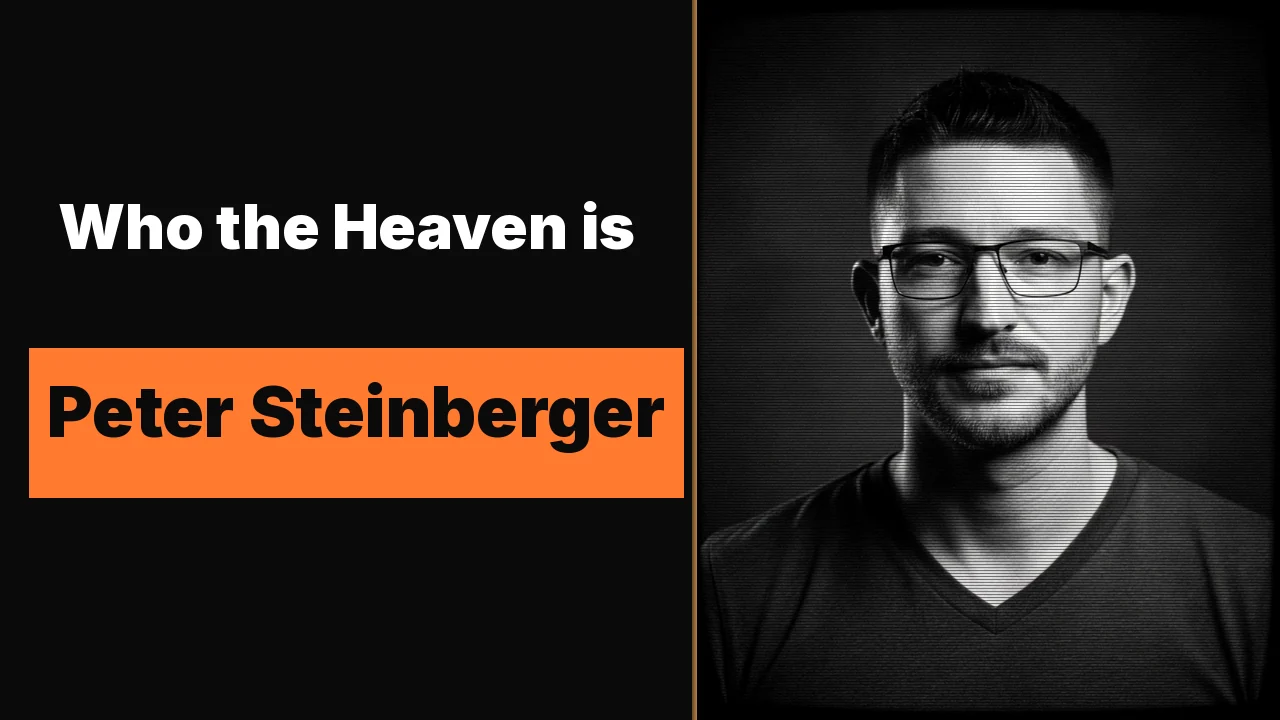
Who the Heaven is Peter Steinberger
A man builds a WhatsApp hack in one hour because he's hungry and annoyed. Eight months later, Nvidia CEO Jensen Huang calls his project the most successful open-source project in human history. We checked what's true about that, and what lies beneath the surface of his own narrative.
From PDF framework bootstrapper to the man whose software allegedly co-caused a Mac Mini bottleneck. The closing sentence of his talk is the key to the entire performance: live slightly ahead of the present, and build what's missing. We show where this attitude actually explains his decisions, where his own narrative is supported by independent journalism, and where it isn't.
Everything in this report is based on this appearance. Watch it before or after you read, then you'll notice yourself what we've contextualized below and what remains his own, unchallenged version.
An Austrian PDF nerd who once burned himself out
Before anyone spoke of "Claw," Peter Steinberger was the founder of PSPDFKit, a PDF software company he bootstrapped while waiting for a US visa. The company grew to around 80 employees, and according to their own statements, their technology eventually ran on a billion devices.
In October 2021, investor Insight Partners entered with growth financing of over 100 million euros. This is independently documented, including directly by Insight Partners themselves. Steinberger and co-founder Martin Schürrer subsequently stepped back from day-to-day operations. In his own narrative, this sounds like a classic exit; the press release reads more like a growth round with withdrawal from operational roles. Both are not mutually exclusive, but it's worth knowing the difference.
What came after, he openly tells himself: around three years in which he barely programmed, instead catching up on life he had foregone while building the company. This burnout phase is consistently recounted in many interviews, but we could find no independent documentation for it, only the same, often repeated self-disclosure.
Real and publicly verifiable, however, are his accounts: GitHub under steipete, his own site steipete.me, X under @steipete. No anonymous Discord myth, a man with a real name and history.
Annoyed, hungry, a kitchen raid, and an agent that took an hour
His own explanation for the origin is disarmingly banal: while a coding agent was working for him, he wanted to go to the kitchen briefly but had no way to check from his phone how far along the agent was. So he had the agent build the solution itself, a simple relay between his computer and WhatsApp. Done in about an hour.
What's remarkable is the structure of this story, not just the content: he explicitly names being annoyed twice as his source of inspiration, once at the very beginning for the very first hack, and once at the very end of the talk when he describes what still drives him today. Eight months of world history lie in between, but the mechanism remains exactly the same.
According to his own account, the WhatsApp relay became a project with its own name over weeks. When someone unsolicited sent a pull request with Discord support, it became more than a feature, it became the moment he himself describes as a turning point: from a one-person tool it became a community project.
Important for context: the core idea of controlling an AI agent via chat instead of terminal was by no means new at that time; many were building similar things. What apparently distinguished his version was less the technology than the feeling: proactive, reduced to the essential, deliberately calibrated outside standard response patterns so it feels less like a tool and more like a counterpart.
Three names in four days, and we're not sure where the count begins
This is where it gets fiddly, and we'd rather say that openly than smooth it over. Multiple independent sources (including Forbes) agree that the project was originally called Clawdbot, named after "Clawd," an unofficial mascot for Claude Code. The official Wikipedia entry for the project tells a different starting story, with an earlier name "Warelay" and a precursor called "Clawd." Both versions cannot simultaneously be the whole truth, and we could not conclusively resolve this before publication.
A system service was to blame, not a marketing plan
This is perhaps the most beautiful punchline of the whole story, and it's in a technical detail. He had set up his project as a launchd service, configured so it automatically restarts after a crash. In the first week of January 2026, he let people interact with his agent in a freshly created Discord server, late into the night.
When he finally wanted to quit with Ctrl-C, the service did exactly what it was built for: it restarted itself after a few seconds and continued answering messages while the builder slept. Around 800 messages accumulated that night, with no one at the wheel.
No launch event, no announcement, no PR plan. A reboot mechanism that did exactly what it was built for, at the most inopportune time for control and the most opportune time for virality.
What came after is independently verifiable: a real Mac Mini shortage, reported among others by Decrypt, though with the fair note that the cause is disputed and should not be monocausally attributed to a single project. And a quote from Nvidia CEO Jensen Huang on a CNBC appearance in March 2026, who publicly used superlatives, verbatim documented and independently verifiable.
An email with 24 hours' notice, and an entire business model falters
His project long ran best optimized with a particular provider model; other models were supported but according to his own account were significantly inferior in quality. When this provider announced with about 24 hours' notice that it would shut off discounted access for everyone, there was barely time for an orderly course correction.
This episode is perhaps the most valuable lesson of the entire talk, far beyond his own project history: whoever ties their product to a single external provider doesn't have their own business model, they're just managing the whims of someone else's. Open weights, he says himself, are significantly better today than at the beginning of this story, but the shock sat deep enough to land as its own agenda item in a conference talk.
He says he remained independent. The headlines say something else.
This is the most interesting discrepancy we found in this research, and it's subtle enough that it doesn't appear in any of the colorful retellings online. In his own talk, he describes in detail how he was courted by "the big labs," spoke on the phone with people he only hints at by first name, compared the whole thing to selling his own soul, and according to his own account ultimately decided against it. His conclusion: he trusted his gut feeling, and it told him he preferred open.
Independently of this, TechCrunch, CNBC, and Bloomberg reported on February 15, 2026, in agreement, that Peter Steinberger was joining OpenAI. This is not vague speculation; these are three serious newsrooms with nearly identical headlines on the same day. Only a good five months later, in July 2026, did he found the OpenClaw Foundation together with Dave Morin as an American non-profit organization, with OpenAI, Nvidia, and Microsoft as documented supporters.
Both can be true simultaneously; an employment relationship with OpenAI and a parallel independently organized foundation project are not necessarily mutually exclusive. But his own talk mentions this OpenAI step nowhere, even though he speaks extensively about precisely this decision. This is not a lie, but it is a conspicuous gap in an otherwise very open narrative.
The Fact table
| Claim | Status |
|---|---|
| PSPDFKit founding, Insight Partners investment 2021 | Independently verified |
| Renaming to Moltbot on Jan 27, OpenClaw on Jan 30, 2026 | Independently verified, original name before disputed |
| Jensen Huang calls it the most successful open-source project | Independently verified, CNBC, March 2026 |
| Mac Mini shortage due to the project | Real, cause disputed among media |
| 18,000+ contributors, 111,000+ issues/PRs, 3,000 committers | Not independently verifiable, only his own dashboard numbers |
| 835,000 to 4.7 million weekly downloads | Not independently verifiable |
| OpenClaw Foundation, 501(c)(3), July 2026 | Independently verified |
| "10 people on payroll", open CEO position | Not independently verifiable |
| Move to OpenAI in February 2026 | Independently verified (TechCrunch, CNBC, Bloomberg), not mentioned in talk itself |
A tribute, because this madness deserved music
John built a dedicated track for this man and this madness. Runs on the same cyber TV as the McGrinsey homepage usually does, only this time completely repainted in lobster-Ferrari-orange. Click play.
🦞 In honor of a man who built perhaps the wildest open-source rollercoaster of the year out of hunger and annoyance. Turn it up.
Yes, the substance is fun, just not meant as mood, but as velocity
"Have fun" and "trust your gut" sound like motivational posters, and that's exactly why it's easy to miss what he actually means: for him, fun isn't a feeling, it's an engineering variable that translates directly into speed. Weeks with genuine curiosity visibly advanced his project, weeks of pure obligation only produced configuration options. Fun equals velocity, that's not a platitude, that's his actual thesis. We searched the talk at exactly this level and distilled fourteen patterns, each in our own words.
Four lessons, regardless of whether you believe every number
Everything this report is based on
We deliberately quote the talk transcript itself only minimally and predominantly paraphrase it; it is the foundation, but not the source for the facts below. Every number we could not independently confirm is explicitly stated in the text as unconfirmed, not as fact.
- Insight Partners: Press release on PSPDFKit investmentPrimary source for the over 100 million euro growth financing in October 2021 and the founders' withdrawal from day-to-day operations.insightpartners.com/ideas/pspdfkit-announces-e100-million-strategic-investment-from-insight-partners-to-fuel-growth
- PR Newswire: same investment announcement, second independent sourceConfirms the figures from the Insight Partners announcement through a second channel.prnewswire.com/news-releases/pspdfkit-announces-100-million-strategic-investment-from-insight-partners-to-fuel-growth-301389571.html
- Forbes (Ron Schmelzer): Renaming from Clawdbot to MoltbotBasis for the name timeline in section 03, including date and Anthropic's trademark claim.forbes.com/sites/ronschmelzer/2026/01/27/viral-ai-sidekick-clawdbot-changes-name-to-moltbot-and-sheds-its-old-skin
- Wikipedia: OpenClaw (project article)Divergent origin story with the name "Warelay", used to expose the inconsistency in section 03, not as sole truth.en.wikipedia.org/wiki/OpenClaw
- CNBC: Jensen Huang calls OpenClaw the most successful open-source projectVerbatim documented statement from March 2026, basis for section 04.cnbc.com/2026/03/17/nvidia-ceo-jensen-huang-says-openclaw-is-definitely-the-next-chatgpt
- Decrypt: OpenClaw and the Mac Mini shortageReports the Mac Mini sellout, with fair note on disputed causality.decrypt.co/366389/openclaw-apple-mac-mini-shortage-ai-2026
- The Hacker News: Koi Security investigation into malicious extensions341 of 2,857 reviewed extensions classified as malicious, around 12 percent, basis for the security table in section 05.thehackernews.com/2026/02/researchers-find-341-malicious-clawhub.html
- TechCrunch: "OpenClaw creator Peter Steinberger joins OpenAI"Basis for the inconsistency in section 07, dated February 15, 2026.techcrunch.com/2026/02/15/openclaw-creator-peter-steinberger-joins-openai
- CNBC and Bloomberg: same OpenAI announcement, two additional newsroomsIndependent second and third confirmation of the OpenAI move on the same day.cnbc.com/2026/02/15/openclaw-creator-peter-steinberger-joining-openai-altman-says
- InfoWorld: Founding of the OpenClaw FoundationConfirms the non-profit founding in July 2026 with Dave Morin and the named supporters.infoworld.com/article/4196376/openclaw-becomes-a-nonprofit-foundation-as-it-seeks-to-be-the-switzerland-of-ai-2
- Peter Steinberger: own accountsGitHub, personal site and X profile, for classification as a real identifiable person with history.steipete.me
McGrinsey's own assessment: Numbers that come exclusively from the talk itself, such as contributor, download and security figures, we have NOT adopted as fact, but clearly marked as unconfirmed self-reported data, even if they sound plausible. The phrase "the anime-like competitor company" from the talk could not be attributed to any specific company and we therefore deliberately leave it unnamed.
This issue is episode 2 of our "Who the hell is" series, after Eugene Schwartz. Both times it was about the same pattern: a reputation that is bigger than what can be cleanly documented, and the work of exposing precisely this gap rather than smoothing it over.
And yes, this issue looks different from the rest of the magazine. That's intentional, not arbitrary, and remains an exception. 🦞