 Artificially generated
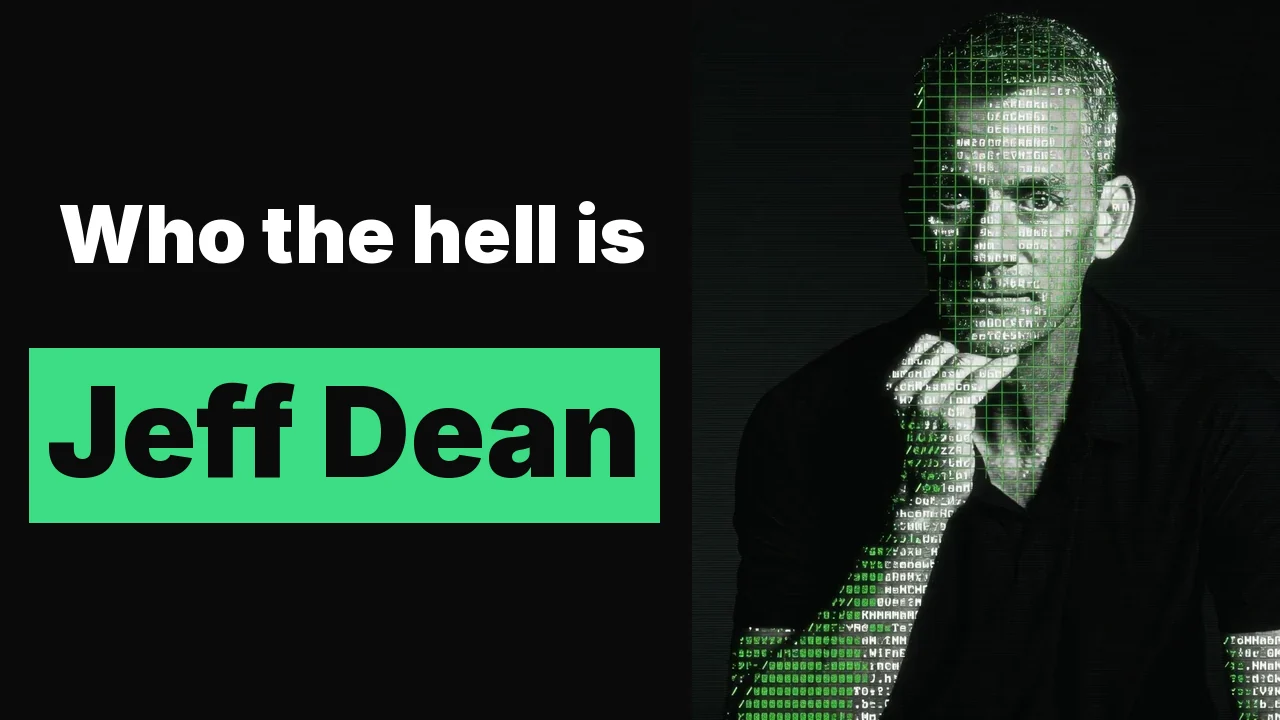
Who the hell is Jeff Dean: never heard of him, you use his work every day
You have never heard of him. You have used his work today anyway, probably more than once, probably before you even got up.
Every Google search runs over infrastructure he helped build. Every product with "Gemini" in the name carries a suggestion he made himself. For 27 years he was, inside Google, the person insiders take for the company's most important engineer, and outside almost nobody recognises him. On 5 August 2026 he left. Not into retirement, not to a competitor: he resigned to build a company that automates science itself.
A man talks for 83 minutes about picojoules per token. You will never guess how few people would recognise him in the street.
February 2026, Latent Space podcast, Alessio Fanelli and Shawn Wang in conversation with Jeff Dean: why distillation is the engine behind every "Flash" model, why the real bottleneck is no longer FLOPs but energy in picojoules, why the next big thing will not come from larger context windows. Six months later the same man resigns from Google.
The conversation is self-report, not an independent source. It does show how he thinks, shortly before he takes the largest decision of his career. Watch it, then the quotes further down in the article are no longer building blocks. They are a real person who builds real sentences.
Latent Space Podcast, 12 February 2026, 1:23:00. Owning the AI Pareto Frontier. Hosts Alessio Fanelli and Shawn Wang. Topics: distillation, energy instead of FLOPs, Pathways, Gemini 3. YouTube · Transcript.
Chuck Norris has facts about himself in circulation. Jeff Dean does too, only a disturbing share of his almost holds.
Jeffrey Adgate Dean, born 23 July 1968 in Hawaii. Employee number 30 at Google, hired in mid-1999, when the company was still twenty, twenty-five people above a shop in Palo Alto. He co-built MapReduce, co-built Bigtable, co-built Spanner, co-founded Google Brain, helped shape TensorFlow and personally suggested the name "Gemini". On 5 August 2026, after 27 years, he resigned.
The punch: almost nobody outside the software industry knows his name. Inside the industry a meme genre of its own has circulated about him since 2007, in the style of Chuck Norris jokes, called "Jeff Dean Facts". A person about whom experienced exaggerations circulate, because the real facts are already absurd enough.
From his parents' field camp straight to the World Health Organization, at 22.
His father researched tropical diseases, later as an epidemiologist in public health. His mother, a PhD medical anthropologist, did field research in Uganda, Somalia, the Ozarks, Minneapolis, Hawaii. The family moved often because of the parents' fieldwork. Jeff Dean went to school around the Twin Cities roughly from fifth to tenth grade.
1990: bachelor's in Computer Science and Engineering, University of Minnesota, summa cum laude, thesis on neural nets, written in C, supervised by Vipin Kumar. Between degree and doctorate: a year at the World Health Organization, AIDS programme, where he built statistical software to model the HIV pandemic.
1996: PhD in computer science at the University of Washington, supervised by Craig Chambers, on compiler optimisation across whole programmes. Directly after, 1996 to 1999: Digital Equipment Corporation, later Compaq, Western Research Lab in Palo Alto, profiling tools and hardware design for processors. That is exactly where the collaboration with a colleague named Sanjay Ghemawat begins, which will last 27 years.
Early 1999 a short stint at mySimon, an early price-comparison startup, distributed web crawling and full-text indexing. Mid-1999 he moves to a small search company called Google. He is the 30th person to take a job there.
Employee number 30 climbs in 27 years to Chief Scientist of a $3 trillion company. Then he resigns himself.
One axis, one path: his titles at Google, 1999 to 2026. Each point is a career jump with its own date. The line draws itself from left to right.
The exact date of the promotion to "Senior Fellow", Google's highest technical rank, is evidenced with a year in no checked source: left out here on purpose rather than guessed.
Four papers, together cited more often than the entire computer-science faculty of some countries in a decade.
MapReduce (2004, with Sanjay Ghemawat): a programming model that spreads huge data volumes across clusters of cheap servers. Became the blueprint for Apache Hadoop, which market data still puts in thousands of companies worldwide.
Bigtable (2006): Google's distributed, sorted store for structured data. For a time it carried Search, Gmail, Maps, YouTube, Google Earth, Drive at once. In 2016 it received the SIGOPS Hall of Fame Award for the most influential systems papers of the previous decade.
Protocol Buffers (internal from 2001, open since 2008): Google's language-neutral format for serialising data. Today on GitHub with over 71,000 stars, built into practically every larger software project somewhere.
Spanner (2012): the first globally distributed database with synchronous transactions across continents, made possible by a self-built time synchronisation called TrueTime. Won the Jay Lepreau Award for the best paper at the OSDI conference 2012.
Google Scholar profile of Jeff Dean, as of 13 August 2026. Citation counts swing by counting service (ACM, for example, counts only 2,140 for MapReduce). Here the Scholar number as a comparable base across all four.
*Spanner number from Semantic Scholar, not Google Scholar: the direct Scholar query delivered no solid values in the research. Likely an undercount compared with the other three bars.
1,000 machines, 3 days, 10 million images. Nobody told the machine what a cat is.
In 2011 Dean founds "Google Brain" with Google researcher Greg Corrado and then Stanford professor Andrew Ng, at first as a 20-percent project beside the day job. A year later, ICML 2012 in Edinburgh: an experiment with 16,000 CPU cores, spread across 1,000 machines, trained for three days on 10 million stills from YouTube videos.
No human told the net what to look for. Unsupervised, a single neuron developed a selective response to cat images. No trick, no label, no prompt: pure scale. The moment is taken by many as the starting gun of the current deep-learning wave at Google.
Each square stands illustratively for about 36 CPU cores, not for a single one. Real ratio 16,000 cores on 1,000 machines, condensed here into a readable grid.
Two open-source libraries, together more than 233,000 stars on GitHub.
TensorFlow, opened on 9 November 2015, grown out of the internal system DistBelief, which came directly out of the cat-neuron experiment. JAX, since 2018, today the base on which Google, by its own account, trains Gemini and Gemma. Both together with Protocol Buffers and LevelDB: four open libraries from the same hand that now sit in millions of projects.
TensorFlow in addition: 76,000 forks, over 3,800 contributors, the 2016 paper with 44,439 citations, the highest number in this whole article.
3.2 quadrillion tokens a month. Two years ago the number was still nine digits.
After the merger of Google Brain and Google DeepMind in April 2023 Dean becomes Chief Scientist of both organisations and, by his own LinkedIn description, "overall technical co-lead" of Gemini. He suggested the name himself: "like twins coming together", the fusion of two AI organisations into one.
At the I/O keynote in May 2026 Sundar Pichai names a number that makes everything said before look small: 3.2 quadrillion tokens processed a month, across Search, the Gemini app, YouTube, Workspace and Cloud together. Critics such as The Decoder counter that the number is not normalised per query as a PR metric, so it is inflated. Both can be true at once.
Logarithmic scale, otherwise the first three points would vanish as a flat line on the floor of a linear axis. The Decoder, May 2026: the metric measures total consumption, not efficiency per query, and is to be read as growth PR with caution.
More than doubled in 14 months, on the way to a billion. Source: Google earnings disclosures and press aggregation, see sources.
Six hours for a chip design that takes humans weeks.
2021, journal Nature: a reinforcement-learning system that automates the physical design of chips, with Dean as co-author. AlphaChip now sits in the last three generations of Google's own AI chips, the Tensor Processing Units.
Weeks of human design work, compressed into a night shift for the machine.
He resigns himself, after 27 years, with a tweet.
5 August 2026. Jeff Dean posts on X: "Announcing Discovery Loop! […] we are founding Discovery Loop, a Public Benefit Corporation whose mission is to automate machine learning, science and engineering to accelerate discovery and progress. The four of us have worked together for 14 to 30 years and have co-built some of the world's most used products, infrastructure and AI models."
Sundar Pichai, the same night, on the official Google blog: "After an incredible 27-year run, Jeff Dean is at a point where he wants to try something new, and we are glad to support him in that." Google appears as founding investor and cloud partner, at least for the first year.
The mission in Dean's own words, second post: "Our approach is to automate the experimentation loop. We think this approach is broadly applicable across many fields of science and engineering. Initially we are focusing on ML research and engineering…" To the New York Times, clearer: "You get a higher number and a higher quality of experiments, and that leads to scientific breakthroughs."
The seed round is jointly led by Radical Ventures and Khosla Ventures, amount and valuation not disclosed, the round was not yet closed at the time of the announcement. Base: Palo Alto.
Succession at Google: Demis Hassabis steps back as operating DeepMind chief, becomes DeepMind Chairman and additionally takes the newly created role of Alphabet Chief Scientist, which partly absorbs Dean's old title. Koray Kavukcuoglu, previously DeepMind CTO, becomes SVP and runs DeepMind operationally, reporting directly to Sundar Pichai.
Four names found with him. Two others were already gone, and that is a different story.
Important not to mix: the four Discovery Loop founders resigned together, with a shared plan. The two departures in June 2026 are independent individual decisions, to other companies, for other reasons.
| Who | Where to | When | Link to Discovery Loop |
|---|---|---|---|
| Jeff Dean, Sanjay Ghemawat, Oriol Vinyals, Quoc Le | Discovery Loop, their own company | 5 Aug. 2026 | Are Discovery Loop, founded together |
| Noam Shazeer | OpenAI | 18 June 2026 | None. Own move, seven weeks earlier |
| John Jumper (AlphaFold, Nobel Prize in Chemistry 2024) | Anthropic | 19 June 2026 | None. After about 9 years at DeepMind |
Alphabet stock fell around 5 to 6 percent around the June departures, and around Dean's own announcement in August another roughly 5 percent. Both price reactions independently evidenced, both events independent of each other.
600 people in a team, 4,400 in the whole organisation. Both numbers from the same source we could not read against directly.
The boss, the investor, his own manager: three very different sources, one pattern.
Himself, short and without a detour
"Very simple techniques work incredibly well when you have enough data."
Google Cloud Blog, ML talk
"One of the beauties of software is that small groups of people can build things with enormous impact."
Commencement, University of Washington, June 2026
2016, Forbes interview, on the arrival of AGI: "I think we are fifteen to fifty years away, probably closer to the lower end of that range." Ten years later he founds a company whose only purpose is to shorten exactly that span. In the same interview, on doomsday scenarios: "I am not a big believer in some of the doom scenarios."
The critical side, thin as it is
In years of coverage not a single named critic was found who personally questions Dean's competence, leadership or conduct. That itself is a finding, not a gap in the research result. Two things come closest: first Dean himself, who in 2013 explicitly relativised the "Jeff Dean Facts" to Slate, "a little embarrassing, but also flattering", with the note that his real successes were almost always the product of collaboration, not of solitary genius.
Second an anonymous single source at Forbes, 6 August 2026: an unnamed former employee, allegedly more than ten years at DeepMind, says Dean's influence in the house had "gradually waned" since the 2023 merger. A single, unnamed voice, to be treated clearly as rumour, not as fact. A Fortune piece of 10 August 2026 on missed deadlines and burnout at Google DeepMind does not name Dean as responsible at any point.
"If Jeff Dean can't sleep, he mapreduces sheep." That one is invented. Almost everything else here is researched.
2007 or 2008, the exact year is no longer evidenced: a Google engineer named Kenton Varda builds internally, as an April Fool, a Chuck Norris Facts parody about Jeff Dean and posts it anonymously to a company mailing list. Dean finds the author via internal logs within an hour or two. In 2013 Slate makes an article of it, "How a Google Programmer Became the Chuck Norris of the Internet", and the internal insider anecdote becomes a public meme. Dean himself calls it "a little embarrassing, but also flattering."
These five sentences are quoted word for word from the 2013 Slate article, itself already marked there as folklore. Further variants in circulation, for instance an alleged reply by Dean in binary to the question whether the facts are true, could not be traced to a primary source: left out here on purpose rather than sold as a quote.
Three baskets, no fourth drawer called "sounds good".
| Claim | Status |
|---|---|
| Date of birth, education, stations at WHO/DEC/mySimon/Google | Fact. Independently evidenced more than once: ACM, UW Allen School, Wikipedia with New Yorker source |
| Departure from Google, founding of Discovery Loop, date, co-founders, investors | Fact. Primary source: Dean's own X post, Google blog, company site, press-backed more than once |
| Citation counts of the four systems papers | Fact, with swing. Counting services diverge (example MapReduce: 2,140 at ACM, 37,395 at Scholar), here consistently one source per comparison |
| Google Brain around 600 staff at peak, Google Research/AI around 4,400 | Hypothesis, medium confidence. Traced to a Bloomberg paywall, confirmed via two secondary sources, not read against the original |
| Whether Dean formally remains Senior Fellow or adviser at Google | Contradictory. One search summary claims it, the deeper research found no independent confirmation: left open here on purpose |
| "Jeff Dean is a co-author of 'Attention Is All You Need'" | False. Eight authors, Dean is none of them. Circulates as an AI-generated search error, expressly refuted here |
| Jeff Dean Facts, verbatim quotes 1 to 5 of this article | Folklore, cleanly evidenced. Word for word from Slate 2013, itself marked there as a joke, never meant as biography |
| Additional "Jeff Dean Facts" from other collections (PIN code, binary reply on request) | Unevidenced. Found only in rebuilt fan archives, no primary source: deliberately not taken into section 13 |
| Anonymous claim that Dean's influence has fallen since 2023 | Rumour. One unnamed single source at Forbes, to be read explicitly as such |
- Wikipedia, "Jeff Dean"Cross-referenced against New Yorker, CNBC, WSJ, NYT quotes.en.wikipedia.org/wiki/Jeff_Dean
- ACM, "People of ACM: Jeff Dean"Official short biography, WHO station, DEC, mySimon, awards.acm.org/articles/people-of-acm/2013/jeff-dean
- The New Yorker, "The Friendship That Made Google Huge"James Somers, December 2018. Source of most colleague quotes.newyorker.com/…/the-friendship-that-made-google-huge
- GeekWire, departure and Discovery Loop motivationAugust 2026, including UW commencement June 2026.geekwire.com/2026/…
- TechCrunch, departure report5 August 2026.techcrunch.com/2026/08/05/…
- CNBC, three reports 2018/2023/2026Title change Google AI, Brain/DeepMind merger, departure.cnbc.com/2026/08/05/…
- Jeff Dean on X, founding announcement5 August 2026, primary source for quote and company name.x.com/JeffDean/status/2085034604172603724
- Discovery Loop, official siteMission, team, seat Palo Alto.discoveryloop.com
- Radical Ventures, investment postOwn interest disclosed, source for investor quote.radical.vc/our-investment-in-discovery-loop
- Google blog, Sundar Pichai on the departure5 August 2026.blog.google/company-news/…
- Slate, "Jeff Dean Facts"Will Oremus, January 2013. Source for section 13, quoted word for word.slate.com/technology/2013/01/jeff-dean-facts
- Jeff Dean's Google Scholar profileCitation counts MapReduce, Bigtable, TensorFlow paper.scholar.google.com/citations?user=sdcsQb4AAAAJ
- Semantic Scholar, Spanner paperCitation count, because the direct Scholar query was unreliable.semanticscholar.org/paper/…
- Google Cloud Blog, Bigtable SIGOPS Hall of Fame2016.cloud.google.com/blog/…
- EE Times / NPR, cat-neuron experiment2012, cores, machines, image count.eetimes.com/…
- Google Open Source Blog, TensorFlow release9 November 2015.opensource.googleblog.com/2015/11/…
- GitHub, tensorflow/tensorflow, jax-ml/jax, protocolbuffers/protobuf, google/leveldbLive star/fork counts, as of 13 August 2026.github.com/tensorflow/tensorflow
- DeepMind blog, AlphaChipTPU generations, wirelength numbers.deepmind.google/blog/…
- Google I/O 2026 keynote / press aggregation, token growth3.2 quadrillion tokens/month, May 2026.gigazine.net/gsc_news/en/…
- The Decoder, reading of the token metricCritical reading of the PR metric.the-decoder.com/…
- Forbes, anonymous criticism & Nieva research6 August 2026, single source, marked as rumour.forbes.com/sites/richardnieva/…
- Fortune, DeepMind internals10 August 2026, does not name Dean as responsible at any point.fortune.com/2026/08/10/…
- SearchEngineJournal, Shazeer and Jumper departuresJune 2026, separate from Discovery Loop.searchenginejournal.com/…
- Forbes 2016, AGI time-horizon quotePeter High, "A Tour Inside Google's Brain".forbes.com/sites/peterhigh/…
- Latent Space Podcast, "Owning the AI Pareto Frontier"12 February 2026, source of the embedded video.latent.space/p/jeffdean